Tuesday, December 1, 2020

Government Accountability Office (GAO) 2020 Report on 5G

November 30, 2020 (Updated December 1, 2020)

 On November 24, 2020, the U.S. Government Accountability Office (GAO) published a report on 5G. The GAO recognizes that public concern regarding the health effects from exposure to radiofrequency radiation (RFR) is likely to intensify with the deployment of 5G technology.

The report acknowledges that policy makers are faced with a challenge as they need relevant information on the health effects of 5G, but long-term effects are unknown. The report recommends that "(p)olicymakers will need to identify a funding source or determine which existing funding streams to reallocate" to pay for the needed research. 

The GAO interviewed government officials who dismissed the research on RFR health effects: "Officials from federal regulatory and research agencies did not indicate any cause for alarm due to these unknowns because of the research from observational studies on pre-5G technology and from experimental studies of high-band 5G technology." 

How can these officials ignore the results of the government's $30 million study which proved that long-term exposure to RFR caused cancer or the Ramazzini Institute study which reproduced these results using much lower intensity RFR? How can they ignore the results of epidemiologic studies that find increased tumor risk among heavier cell phone users?

"In 2008, a committee convened by the National Research Council (part of the National Academies of Sciences, Engineering, and Medicine) reported that further research was needed to characterize exposure to RF energy in juveniles, young children, and pregnant women and fetuses in observational studies." So why didn't our government fund the research needed to ask the critical questions re: RFR exposure that would enable our health agencies to adopt protective safety limits?

"While research on the biological effects of RF energy has been underway for decades, FDA officials do not expect changes to the current safety standards from 5G technology."

For more than two decades, FDA officials have ignored the lack of consensus in the scientific community regarding the safety of RFR. The majority of scientists who study RFR effects now believe that current RFR national and international safety standards are inadequate to protect our health. More than 240 scientists from 44 countries who have published over 2,000 papers in professional journals on electromagnetic fields (EMF) and biology or health have signed the International EMF Scientist Appeal which calls for stronger safety standards and health warnings.

The GAO report also failed to mention the 5G Appeal signed by more than 400 scientists and doctors who have demanded a moratorium on the deployment of 5G. 


Government Accountability Office (GAO-21-26SP), Nov 24, 2020

What GAO Found

Fifth-generation (5G) wireless networks promise to provide significantly greater speeds and higher capacity to accommodate more devices. In addition, 5G networks are expected to be more flexible, reliable, and secure than existing cellular networks. The figure compares 4G and 5G performance goals along three of several performance measures.
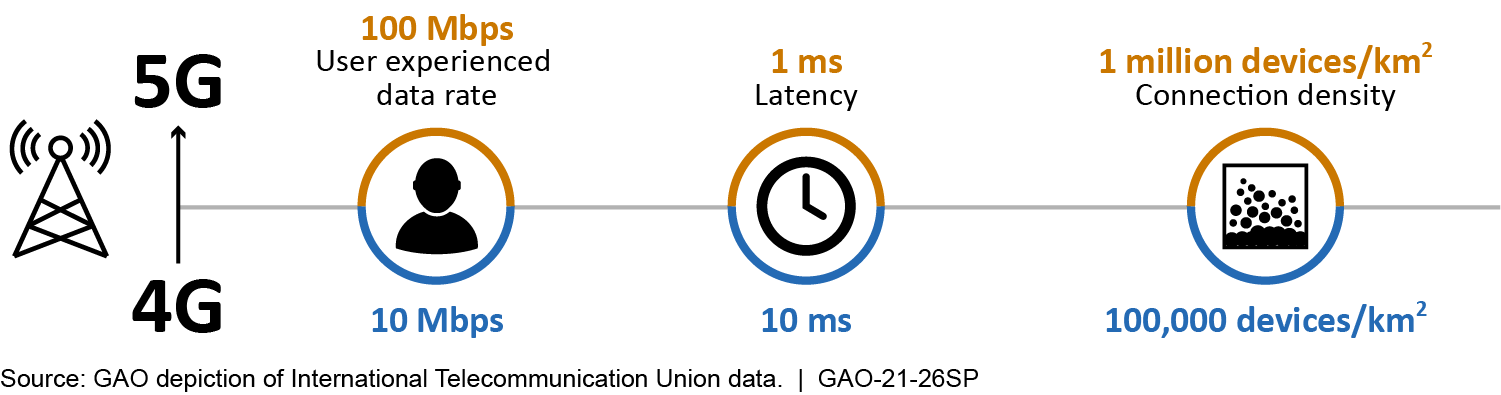
Note: Megabits per second (Mbps) is a measure of the rate at which data is transmitted, milliseconds (ms) is a measure of time equal to one thousandth of a second, and square kilometer (km²) is a measure of area.

As with previous generations of mobile wireless technology, the full performance of 5G will be achieved gradually as networks evolve over the next decade. Deployment of 5G network technologies in the U.S. began in late 2018, and these initial 5G networks focus on enhancing mobile broadband. These deployments are dependent on the existing 4G core network and, in many areas, produced only modest performance improvements. To reach the full potential of 5G, new technologies will need to be developed. International bodies that have been involved in defining 5G network specifications will need to develop additional 5G specifications and companies will need to develop, test, and deploy these technologies. GAO identified the following challenges that can hinder the performance or usage of 5G technologies in the U.S.
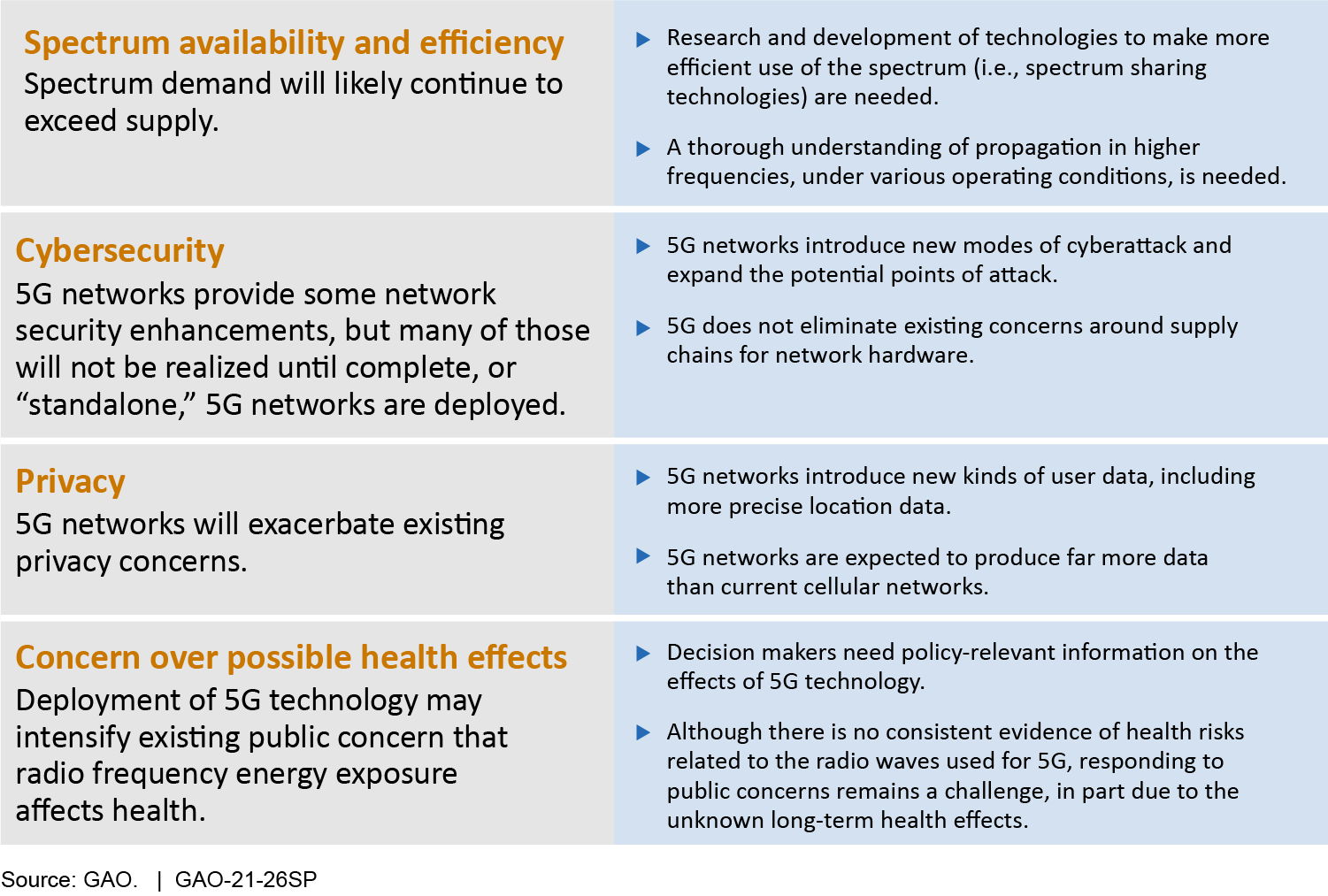
GAO developed six policy options in response to these challenges, including the status quo. They are presented with associated opportunities and considerations in the following table. The policy options are directed toward the challenges detailed in this report: spectrum sharing, cybersecurity, privacy, and concern over possible health effects of 5G technology.

Policy options to address challenges to the performance or usage of U.S. 5G wireless networks

Policy OptionOpportunitiesConsiderations

Spectrum-sharing technologies (report p. 47)


Policymakers could support research and development of spectrum sharing technologies.

  • Could allow for more efficient use of the limited spectrum available for 5G and future generations of wireless networks.
  • It may be possible to leverage existing 5G testbeds for testing the spectrum sharing technologies developed through applied research.
  • Research and development is costly, must be coordinated and administered, and its potential benefits are uncertain. Identifying a funding source, setting up the funding mechanism, or determining which existing funding streams to reallocate will require detailed analysis.

Coordinated cybersecurity monitoring (report p. 48)


Policymakers could support nationwide, coordinated cybersecurity monitoring of 5G networks.

  • A coordinated monitoring program would help ensure the entire wireless ecosystem stays knowledgeable about evolving threats, in close to real time; identify cybersecurity risks; and allow stakeholders to act rapidly in response to emerging threats or actual network attacks.
  • Carriers may not be comfortable reporting incidents or vulnerabilities, and determinations would need to be made about what information is disclosed and how the information will be used and reported.

Cybersecurity requirements (report p. 49)


Policymakers could adopt cybersecurity requirements for 5G networks.

  • Taking these steps could produce a more secure network. Without a baseline set of security requirements the implementation of network security practices is likely to be piecemeal and inconsistent.
  • Using existing protocols or best practices may decrease the time and cost of developing and implementing requirements.
  • Adopting network security requirements would be challenging, in part because defining and implementing the requirements would have to be done on an application-specific basis rather than as a one-size-fits-all approach.
  • Designing a system to certify network components would be costly and would require a centralized entity, be it industry-led or government-led.

Privacy practices (report p. 50)


Policymakers could adopt uniform practices for 5G user data.

  • Development and adoption of uniform privacy practices would benefit from existing privacy practices that have been implemented by states, other countries, or that have been developed by federal agencies or other organizations.
  • Privacy practices come with costs, and policymakers would need to balance the need for privacy with the direct and indirect costs of implementing privacy requirements. Imposing requirements can be burdensome, especially for smaller entities.

High-band research (report p. 51)


Policymakers could promote R&D for high-band technology.

  • Could result in improved statistical modeling of antenna characteristics and more accurately representing propagation characteristics.
  • Could result in improved understanding of any possible health effects from long-term radio frequency exposure to high-band emissions.
  • Research and development is costly and must be coordinated and administered, and its potential benefits are uncertain. Policymakers will need to identify a funding source or determine which existing funding streams to reallocate.
Status quo (report p. 52)
  • Some challenges described in this report may be addressed through current efforts.
  • Some challenges described in this report may remain unresolved, be exacerbated, or take longer to resolve than with intervention.

Why GAO Did This Study

GAO was asked to assess the technologies associated with 5G and their implications. This report discusses (1) how the performance goals and expected uses are to be realized in U.S. 5G wireless networks, (2) the challenges that could affect the performance or usage of 5G wireless networks in the U.S., and (3) policy options to address these challenges.

To address these objectives, GAO interviewed government officials, industry representatives, and researchers about the performance and usage of 5G wireless networks. This included officials from seven federal agencies; the four largest U.S. wireless carriers; an industry trade organization; two standards bodies; two policy organizations; nine other companies; four university research programs; the World Health Organization; the National Council on Radiation Protection and Measurements; and the chairman of the Defense Science Board's 5G task force. GAO reviewed technical studies, industry white papers, and policy papers identified through a literature review. GAO discussed the challenges to the performance or usage of 5G in the U.S. during its interviews and convened a one-and-a-half day meeting of 17 experts from academia, industry, and consumer groups with assistance from the National Academies of Sciences, Engineering, and Medicine.

GAO received technical comments on a draft of this report from six federal agencies and nine participants at its expert meeting, which it incorporated as appropriate.

For more information, contact Hai Tran at (202) 512-6888, tranh@gao.gov or Vijay A. D’Souza at (202) 512-6240, dsouzav@gao.gov.


The 2020 GAO report can be downloaded: from https://www.gao.gov/assets/720/710861.pdf .


Excerpt from the 2020 GAO report (pp. 40-45)

"3.4 Concern over possible health effects

The deployment of 5G technology, including the numerous small cell base stations needed to transmit and receive high-band frequencies, may exacerbate existing public concerns that RF energy exposure may cause cancer 93 or otherwise endanger human health, although there is limited evidence to support these concerns. Several U.S. localities, private citizens, and non-profits have filed lawsuits involving the deployment of 5G, including claims that the FCC has failed to update its RF exposure limits in light of the new technology. 94 Health concerns have also interrupted 5G deployment abroad, with several Swiss communities delaying rollouts, and protesters in the United Kingdom and the Netherlands damaging 5G towers.

To respond to public concerns, decision makers need policy-relevant information on the long-term health effects of 5G technology. Although there is currently no consistent evidence of health risks related to 5G RF exposure in humans, responding to public concerns remains a challenge, in part due to the possibility of unknown long-term health effects and the challenges in researching this topic.

3.4.1 Unknown long-term health effects

While research on the biological effects of RF energy has been underway for decades, research on the long-term health effects of pre-5G technology is ongoing and research on the possibility of long-term health effects of 5G technology is largely unknown because the technology is still new and has not been widely deployed.

Officials from federal regulatory and research agencies did not indicate any cause for alarm due to these unknowns because of the research from observational studies on pre-5G technology and from experimental studies of high-band 5G technology. 95 The National Cancer Institute (NCI) reviewed three large observational studies and several smaller observational studies of humans exposed to pre-5G technology. 96 The results of the large studies were inconsistent in linking cell phones and cancer outcomes and methodological challenges may have affected the findings. A few of the smaller studies showed a relationship with non-malignant tumors. 5G technology introduces RF energy at higher frequencies than used for existing cellular communications systems. However, higher frequencies have less penetration into the human body and therefore are thought to be less of a concern than lower frequencies.

While research on the biological effects of RF energy has been underway for decades, FDA officials do not expect changes to the current safety standards from 5G technology.

According to officials, the unknown long-term health effects and R&D opportunities related to 5G technology include the following:

• High-band 5G frequencies. The latest IEEE standard on electromagnetic safety published in 2019 focused on the effects of frequencies above 6 GHz in experimental studies. However, no studies have been carried out on the long-term health effects of high-band 5G frequencies in observational studies, such as those in settings experienced by the general public, because the technology has not been deployed for long enough or widely enough to conduct these studies. According to an NCI scientist, even after high-band 5G technology has been put into use in the coming years, the long-term health effects on people, if any, may not be known for many years later because some health outcomes could take decades to develop. The high-band frequencies used in 5G will only be available for observational studies once 5G technology has been deployed widely. A National Institutes of Health scientist noted that the 5G frequencies are still not clearly defined, making it difficult to understand the impact on human exposure.

• Active antennas with beamforming. FCC stated that RF exposure below the exposure limits are safe. However, no research has been conducted to characterize long-term exposure to the multiple active antennas with beamforming that are a feature of 5G. It is unknown how the signals from these antennas may affect human health in the long-term. It could be computationally intensive to study the long-term exposure to these antennas due, in part, to their many possible configurations, which may increase or decrease the RF energy exposure. According to NIST experts, a statistical model is needed to study these configurations, and it will be necessary to evaluate this model against measurements of actual systems. NSF officials believe that artificial intelligence techniques have the potential to better address this modeling challenge.

• Certain high-risk populations, cancer, and non-cancer outcomes. In 2008, a committee convened by the National Research Council (part of the National Academies of Sciences, Engineering, and Medicine) reported that further research was needed to characterize exposure to RF energy in juveniles, young children, and pregnant women and fetuses in observational studies. 97 An NCI scientist we interviewed reiterated these unknown long-term health effects for pre-5G technology and with respect to 5G. Further research was also needed for non-cancer outcomes, such as developmental and behavioral outcomes, according to the committee proceedings and the NCI scientist. Observational studies may be used to study health outcomes that take years and decades to behavioral, and cancer outcomes. However, as mentioned above, there have been no observational studies on the long-term health effects of high-band 5G frequencies because the technology is still new.

3.4.2 Research challenges

Challenges in understanding research on the possibility of long-term health effects of exposure to RF energy from pre-5G and 5G technology include: (1) measuring RF exposure to populations, and (2) synthesizing research for decision makers and for the public.

Measuring population exposure to RF

Measuring RF exposure in observational studies is a challenge, but these types of studies are of interest in making policy relevant recommendations. Observational studies ask participants to report their current cell phone use, or attempt to measure RF exposure. Yet asking participants about their current cell phone use or using cell phone call logs may not be a good proxy for RF exposure, since people may use phones for more than voice calls and call logs do not account for potential exposure to surrounding small cells and base stations, Wi-Fi networks, and other environmental exposures. NCI scientists noted that cancer and other chronic exposures require collection of not only current RF exposures, but past RF exposures that may contribute to total exposure. The type of RF exposure relevant to health outcomes is also unknown whether it be peak exposure or cumulative, according to NCI scientists. However, none of the recent observational studies attempted to estimate the entire accumulated RF dose in the individual environments of the study subjects.

To better address the measurement of RF exposure in future studies involving high-band frequencies, an NCI scientist noted that studies that measure exposure to RF energy and the amount of RF energy deposited into the body (dosimetry) would first need to be performed to prepare for human observational studies and to help understand how exposure is different with 5G technology.

Synthesizing research for decision makers and the public

Due to the challenges of measuring long-term exposure to RF energy and unavailability of the evidence at this time, assessments of 5G technology will likely be based on human or animal experimental studies (usually short-term) and human observational studies that rely on self-reporting exposure to RF energy, all of which have limitations. The experimental studies may not be relevant to long-term human exposure to RF energy as studies conducted over a shorter period may not detect outcomes that take decades to develop. As noted above, self-reporting may not be a good proxy for total, peak, or cumulative exposure to RF energy.
Because there is a large and evolving body of relevant research, it is important that the results be regularly synthesized for Congress and the public. The FCC relies on the FDA as well as other organizations—principally IEEE and the National Council on Radiation Protection and Measurements (NCRP)—to review scientific research and provide recommendations for setting RF safety standards. 98 However, each of these organizations has only reviewed a subset of the relevant research and, of these organizations, only IEEE updates its formal assessments regularly. Specifically:

• According to officials, the FDA monitors peer-reviewed science regarding RF energy and health. The agency does not typically make its assessments publicly available, but released one assessment publicly in February 2020. 99 The assessment focused on cancer-related animal and human studies of frequencies below 6 GHz. The assessment did not include non-cancer outcomes or frequencies above 6 GHz. The agency does not have plans to update this review for the FCC unless it becomes aware of research that would lead it to change its current assessment, that the current scientific evidence has not linked RF energy from cell phones with health problems in humans. 

• IEEE has periodically published standards for RF energy exposure in 1991, 2005, and 2019.100 While IEEE does include reviews of observational studies of frequencies below 6 GHz in its latest standard, its assessment of those studies was that many were weak in terms of their design and exposure assessment. The IEEE noted, “while the available results do not indicate a strong causal association, they cannot establish the absence of a hazard.” The review did not include observational studies above 6 GHz because the technology has not been deployed for long enough or widely enough to conduct these studies, as mentioned above.

• NCRP reviewed two larger observational studies in its 1986 review; however, it has not published an update since. 101 The studies reviewed included a retrospective study of U.S. naval personnel conducted by the National Academies of Sciences and a retrospective study of American embassy personnel in Moscow conducted by Johns Hopkins University. 102  Neither study found evidence of an association between RF energy and adverse outcomes. The naval study used occupation as a proxy for exposure to RF energy, and the embassy study was not able to obtain complete information on exposures and outcomes for participants. These studies focused on persons occupationally exposed to RF energy and may not be relevant to public exposure to RF energy."

Agency comments

"We provided a draft of this product to the Departments of Commerce, Energy, and Health and Human Services; DHS; DOD; FCC; and NSF for their review. DOD told us that they had no technical comments on the draft report; the remaining six agencies provided technical comments, which we incorporated as appropriate. Participants in our expert meeting from CTC Technology & Energy, CTIA, Google, Illinois Institute of Technology, National Consumer Law Center, Nokia—North and South America, PwC, University of Colorado, and U.S. Cellular also reviewed a draft of this product; we incorporated their technical comments as appropriate."

Appendix I

"To understand the health effects of wireless technology, we interviewed officials from the Department of Health and Human Services, the National Council on Radiation Protection and Measurements, and the World Health Organization; reviewed safety standards; and reviewed assessments published by DOD, FDA, and the National Institutes of Health. We also requested and reviewed a DOD bibliography of peer-reviewed articles, technical notes, technical reports, and special reports published in fiscal years 1997 through 2019 on the physiological effects of microwave or millimeter wave energy."

Footnotes

93 The RF spectrum used in cellular communications has not been definitively linked to cancer or other health outcomes, according to FCC and FDA. The lower frequencies of the radio frequency spectrum that are used for wireless communication, including 5G communication, are considered “nonionizing radiation” because these frequencies lack sufficient energy to remove electrons from atoms and molecules. In contrast, X-rays are considered “ionizing” radiation, which can have significant human health effects and are known to increase the risk of cancer. The radio frequencies used by cellular communications systems can lead to tissue heating, but is not thought to emit enough RF energy to cause harmful heating.

94 The U.S. Court of Appeals for the Ninth Circuit dismissed a challenge claiming that FCC failed to reassess its RF exposure limits, because, by the time of the decision, FCC had completed its evaluation of the effects of 5G technology on its RF updated. City of Portland v. United States, 969 F.3d 1020, 1046-47 (9th Cir. 2020). FCC’s evaluation and decision not to update its RF exposure limits is currently being challenged in the D.C. Circuit Court of Appeals. Brief of Petitioners at 65-69, Environmental Health Trust v. FCC, No. 20-1025 (D.C. Cir. July 29, 2020).

95 Experimental studies are those in which the exposure to RF energy is determined by the investigator. Observational studies are those where exposure to RF energy is observed (usually reported or measured).

96 NCI reviewed the Interphone, Million Women Study, Danish Registry Linkage Study, which all evaluated 2G and 3G technologies; RF exposure from high-band 5G technology was not evaluated in these studies. 

97 National Research Council, Identification of Research Needs Relating to Potential Biological or Adverse Health Effects of Wireless Communication Devices, National Academies Press (Washington, D.C.: 2008).

98 While other organizations synthesize the literature on RF energy and health outcomes, we focus on the three organizations (FDA, IEEE, and NCRP) that FCC principally relies on for synthesizing the literature and providing recommendations for setting RF safety standards. NCRP was chartered in law by the U.S. Congress in 1964 to collect, analyze, and disseminate information and recommendations about radiation protection in the public interest. Pub. L. No. 88-376, 78 Stat. 320 (1964). The International Commission on Non-ionizing Radiation Protection (ICNIRP) also synthesizes experimental and observational studies. It is an independent, non-governmental organization chartered in Germany that provides guidelines followed by several European Union countries. IEEE and ICNIRP have been working to harmonize their standards.

99 FDA, Review of Published Literature between 2008 and 2018 of Relevance to Radiofrequency Radiation and Cancer (Silver Spring, Md.: February 2020).

100 According to IEEE officials, the standards have a 10-year revision cycle. However, the standard is a “living” document that may be revised sooner, for example, if the conclusions of an ongoing World Health Organization Environmental Health Criteria systematic review reveal any significant results.

101 NCRP Report No. 86, Biological Effects and Exposure Criteria for Radiofrequency Electromagnetic Fields, 1986. According to an NCRP official, NCRP produces reports at the request and funding of federal agencies. NCRP has not been funded to update Report No. 86.

102 Observational studies may be prospective or retrospective. In prospective studies, participants are enrolled and data are collected on their current exposures. Then, participants are followed up over a period of time (some cohort studies have been ongoing for years) to observe outcomes that develop. In retrospective studies, participants are enrolled and asked about exposures and outcomes that have already occurred. The benefit of a prospective study is that it is less subject to recall bias, which may be present in retrospective studies where outcomes are known and participants are asked to report past exposure.

Health Experts Caution About Smart Meters

Adverse Health Effects from Radiofrequency (RF) Radiation with a Focus of AMI Meters

David O. Carpenter, MD, Institute for Health and the Environment, University at Albany, Rensselaer, New York

Slides from a presentation to the Washington Suburban Sanitary Commission in October 2020.

Conclusions

• EHS (electrohypersensitivity) is real, but not everyone is electrosensitive. There is something about the signals from AMI* smart meters that makes them particularly provocative, probably the very rapid rise and fall of the signals.

• EHS is related to other disease syndromes characterized by similar symptoms. Much more study is needed to determine what are the triggering events and especially what are the mechanisms of action.

• AMI meters benefit the utility but not the consumer.

• Individuals who become ill from AMI meters placed on their home should have the ability to “opt-out” because they are dangerous to the health of those who are sensitive to RF signals.

* AMI = Advanced Metering Infrastructure, an integrated system of smart meters, communications networks, and data management systems that enables two-way communication between utilities and customers.

Slides: https://bit.ly/Carpenter_smart_meters  (link updated 12/10/2020)

--

Feb 1, 2015

"Health Experts Caution About Smart Meters" (9/12/2012), one of my most popular press releases, publicized an open letter that discusses why precaution is warranted with regard to adoption of wireless smart meters. The letter which was signed by 54 scientists and medical professionals was originally published by La Maison du 21e siecle. The letter is reprinted below.

Smart Meters: Correcting the Gross Misinformation

La Maison du 21e siecle, June 11, 2012

Quebec-based magazine La Maison du 21e siecle asked physician David O. Carpenter, former founding dean of the University at Albany (NY)’s School of Public Health, to comment an open letter published in the Montreal daily Le Devoir on May 24 2012. This letter claimed wireless smart meters pose no risk to public health. More than fifty international experts endorsed the following rebuttal.

Dr David O. Carpenter, founder, University at Albany (NY) School of Public Health

We, the undersigned are a group of scientists and health professionals who together have coauthored hundreds of peer-reviewed studies on the health effects of electromagnetic fields (EMFs). We wish to correct some of the gross misinformation found in the letter regarding wireless “smart” meters that was published in the Montreal daily Le Devoir on May 24. Submitted by a group Quebec engineers, physicists and chemists, the letter in question reflects an obvious lack of understanding of the science behind the health impacts of the radiofrequency (RF)/microwave EMFs emitted by these meters.

The statement that « Thousands of studies, both epidemiological and experimental in humans, show no increase in cancer cases as a result of exposure to radio waves of low intensity… » is false (1). In fact, only a few such studies — two dozen case-control studies of mobile phone use, certainly not thousands, have reported no elevations of cancer, and most were funded by the wireless industry. In addition, these reassuring studies contained significant experimental design flaws, mainly the fact that the populations followed were too small and were followed for a too short period of time.

Non industry-funded studies have clearly demonstrated a significant increase in cancer cases among individuals who have suffered from prolonged exposure to low-level microwaves, transmitted notably by radio antennas. The effects were best documented in meta-analyses that have been published and that include grouped results from several different studies: these analyses consistently showed an increased risk of brain cancer among regular users of a cell phone who have been exposed to microwaves for at least ten years. Children and youths are especially vulnerable (2). For example, the 2009 Hardell-Carlberg study reported a consistent association between use of mobile or cordless phones and two types of head tumors, astrocytoma grade I-IV and acoustic neuroma. The authors  »found an especially high risk for persons that started use of mobile or cordless phones before the age of 20 years, although based on low numbers ».

Brain Cancer Rates

Furthermore, the argument that brain cancer rates do not indicate an overall increase in incidence is not evidence that cell phones are safe: the latency for brain cancer in adults after environmental exposure can be long, up to 20-30 years. Most North Americans haven’t used cell phones extensively for that long. The evidence of the link between long-term cell phone use and brain cancer comes primarily from Northern Europe, where cell phones have been commonly used since the 1990s. Nevertheless, the most recent collection of primary brain tumors mined from pathology units in Australia showed brain cancer incidence rose by about 35% between 2000 and 2008 in the Australian Capital Territory and New South Wales (total population : more than 7 million).


In May 2011, after reviewing the published scientific literature regarding cancers affecting cell phone users, the International Agency for Research on Cancer (IARC) classified radiofrequency radiation as a 2B, possible human carcinogen. Despite the absence of scientific consensus, the evidence is sufficiently compelling for any cautious parent to want to reduce their loved one’s exposure to RF/microwave emissions as much as possible, as recommended by various countries such as Austria, Belgium, Germany, Russia and the United Kingdom.

Electrosensitivity

Public fears about wireless smart meters are well-founded. They are backed by various medical authorities such as those of the Santa Cruz County(California) Public Health Department. These authorities are worried about the growing number of citizens who say they have developed electrohypersensitivity (EHS), especially since for many of them, the symptoms developed after the installation of such meters (it takes some time for most people to link the two events).


Since the turn of the millennium, people are increasingly affected by ambient microwaves due to the growing popularity of wireless devices such as cell phones and Wi-Fi Internet. Therefore, the mass deployment of smart grids could expose large chunks of the general population to alarming risk scenarios without their consent. According to seven surveys done in six European countries between 2002 and 2004, about 10% of Europeans have become electrosensitive. The most famous person to publicly reveal her electrosensitivity is Gro Harlem Brundtland, formerly Prime Minister of Norway and retired Director of the World Health Organization (WHO).

While there is no consensus on the origins and mechanisms of EHS, many physicians and other specialists around the world have become aware that EHS symptoms (neurological dermatological, acoustical, etc.) seem to be triggered by exposure to EMF levels well below current international exposure limits, which are established solely on short-term thermal effects (3). Organizations such as the Austrian Medical Association and the American Academy of Environmental Medicine have recognized that the ideal way to treat of EHS is to reduce EMF exposure.

Therefore, caution is warranted because the growing variety of RF/microwave emissions produced by many wireless devices such as smart meters have never been tested for their potential biological effects.

Well-known bioeffects

While the specific pathways to cancer are not fully understood, it is scientifically unacceptable to deny the weight of the evidence regarding the increase in cancer cases in humans that are exposed to high levels of RF/microwave radiation.


The statement that « there is no established mechanism by which a radio wave could induce an adverse effect on human tissue other than by heating » is incorrect, and reflects a lack of awareness and understanding of the scientific literature on the subject. In fact, more than a thousand studies done on low intensity, high frequency, non-ionizing radiation, going back at least fifty years, show that some biological mechanisms of effect do not involve heat. This radiation sends signals to living tissue that stimulate biochemical changes, which can generate various symptoms and may lead to diseases such as cancer.

Even though RF/microwaves don’t have the energy to directly break chemical bonds, unlike ionizing radiation such as X-rays, there is scientific evidence that this energy can cause DNA damage indirectly leading to cancer by a combination of biological effects. Recent publications have documented the generation of free radicals, increased permeability of the blood brain barrier allowing potentially toxic chemicals to enter the brain, induction of genes, as well as altered electrical and metabolic activity in human brains upon application of cell phone RF/microwaves similar to those produced by smart meters.

These effects are cumulative and depend on many factors including RF/microwave levels, frequency, waveform, exposure time, biovariability between individuals and combination with other toxic agents. Clear evidence that these microwaves are indeed bioactive has been shown by the fact that low-intensity EMFs have proven clinically useful in some circumstances. Pulsed EMFs have long been used to successfully treat bone fractures that are resistant to other forms of therapy. More recently, frequency-specific, amplitude-modulated EMFs have been found useful to treat advanced carcinoma and chronic pain.
High frequency EMFs such as the microwaves used in cell phones, smart meters, Wi-Fi and cordless ‘‘DECT’’ phones, appear to be the most damaging when used commonly. Most of their biological effects, including symptoms of electrohypersensitivity, can be seen in the damage done to cellular membranes by the loss of structurally-important calcium ions. Prolonged exposure to these high frequencies may eventually lead to cellular malfunction and death.

Furthermore, malfunction of the parathyroid gland, located in the neck just inches from where one holds a cell phone, may actually cause electrohypersensitivity in some people by reducing the background level of calcium ions in the blood. RF/microwave radiation is also known to decrease the production of melatonin, which protects against cancer, and to promote the growth of existing cancer cells.

Early warning scientists attacked

In recommending that the Precautionary Principle be applied in EMF matters, the European Environment Agency’s Director Jacqueline McGlade wrote in 2009: “We have noted from previous health hazard histories such as that of lead in petrol, and methyl mercury, that ‘early warning’ scientists frequently suffer from discrimination, from loss of research funds, and from unduly personal attacks on their scientific integrity. It would be surprising if this is not already a feature of the present EMF controversy… » Such unfortunate consequences have indeed occurred.


The statement in the Le Devoir letter that « if we consider that a debate should take place, it should focus exclusively on the effects of cell phones on health » is basically an acknowledgement that there is at least some reason to be concerned about cell phones. However, while the immediate exposure from a cell phone is of much greater intensity than the exposure from smart meters, cell phone use is temporary.

Smart meters

As Australian Associate Professor of neurosurgery Vini G. Khurana reports, adverse neurological effects have been reported in people who sustain close proximity to wireless meters, especially under 10 feet (3 metres).


A wireless smart meter produces radiofrequency microwave radiation with two antennas in approximately the same frequency range (900 MHz to 2.4 GHz) as a typical cell tower. But, depending on how close it is to occupied space within a home, a smart meter can cause much higher RF exposures than cell towers commonly do.  If a smart meter is located on a common wall with a bedroom or kitchen rather than a garage wall, for example, the RF exposure can be the same as being within 200 to 600 feet distance of a cell tower with multiple carriers. With both cell towers and smart meters, the entire body is immersed by microwaves  that go out in all directions, which increases the risk of overexposure to many sensitive organs such as the eyes and testicles. With a cell phone, people are exposed to microwaves primarily in the head and neck (unless using speaker mode), and only when the device is turned on or in standby mode.

Wireless smart meters typically produce atypical, relatively potent and very short pulsed RF/microwaves whose biological effects have never been fully tested. They emit these millisecond-long RF bursts on average 9,600 times a day with a maximum of 190,000 daily transmissions and a peak level emission two and a half times higher than the stated safety signal, as the California utility Pacific Gas & Electric recognized before that State’s Public Utilities Commission. Thus people in proximity to a smart meter are at risk of significantly greater aggregate of RF/microwave exposure than with a cell phone, not to mention the cumulative exposure received by people living near multiple meters mounted together, pole-mounted routers or utility collector meters using a third antenna to relay RF signals from 500 to 5,000 homes.

A technical study performed by Sage Associates in California indicates that RF levels from various scenarios depicting normal smart meter installation and operation may violate even the out-of-date US public safety standards which only consider acute thermal effects. This can happen when a person stands close to the meter to read the power consumption, or touches it, or shades the meter face with a hand to better read it. Emissions are also increased by reflective materials, such as stainless steel, other metals and mirrors, which can re-radiate stronger that the otherwise unaltered background. Microwaves are absorbed and dissipated by partially conductive materials, such as cement and special RF shielding paints and fabrics.

In addition to the erratic bursts of modulated microwaves emitted by wireless smart meters transferring usage data to electric, gas and water utilities, wireless as well as wired smart (powerline communication) meters are also a major source of ‘’dirty electricity’’ (electrical interference of high frequency voltage transients typically of kilohertz frequencies). Some scientists, such as American epidemiologist Sam Milham, believe that many of the health complaints about smart meters may also be caused by dirty electricity generated by the « switching » power supply activating all smart meters. Since the installation of filters to reduce dirty electricity circulating on house wiring has been found to relieve symptoms of EHS in some people, this method should be considered among the priorities aimed at reducing potential adverse impacts. Indeed, the Salzburg State (Austria) Public Health Department confirms its concern about the potential public health risk when in coming years almost every electric wire and device will emit such transient electric fields in the kilohertz-range due to wired smart meters.

Rather be safe than sorry

The apparent adverse health effects noted with smart meter exposure are likely to be further exacerbated if smart appliances that use wireless communications become the norm and further increase unwarranted exposure.


To date, there have been few independent studies of the health effects of such sources of more continuous but lower intensity microwaves. However, we know after decades of studies of hazardous chemical substances, that chronic exposure to low concentrations of microwaves can cause equal or even greater harm than an acute exposure to high concentrations of the same microwaves.

This is why so many scientists and medical experts urgently recommend that measures following the Precautionary Principle be applied immediately — such as using wired meters — to reduce biologically inappropriate microwave exposure. We are not advocating the abolishment of RF technologies, only the use of common sense and the development and implementation of best practices in using these technologies in order to reduce exposure and risk of health hazards.

(1) • Scientific papers on EMF health effects
(2) On Nov. 19 2012, we struck from this letter an error propagated in the media claiming that « In May 2012, the U.K.’s Office of National Statistics reported a 50 percent increase in incidence of frontal and temporal lobe tumors in children between 1999 and 2009. »
(3) Explanation and studies on electrosensitivity
(4) 
Governments and organizations that ban or warn against wireless technology


Signers

David O. Carpenter, MD, Director, Institute for Health & the Environment, University at Albany, USA
Franz Adlkofer, M.D., Chairman of the Pandora Foundation, Coordinator of the European Reflex Report on DNA-damage by cellphone radiation, Neuendorf, Germany
M. S. H. Al Salameh, PhD, Professor of Electrical Engineering, University of Science & Technology, Irbid, Jordan
Jennifer Armstrong, MD, Past President, American Society for Environmental Medicine, Founder, Ottawa Environmental Health Clinic, Ontario, Canada
• Pierre L. Auger, MD, Occupational medicine, Multiclinique des accidentés 1464, Montreal, Quebec, Canada
Igor Beliaev, PhD, Head research scientist, Cancer Research Institute, Slovak Academy of Sciences, Bratislava, Slovak republic
Fiorella Belpoggi, PhD, Director Cesare Maltoni Cancer Research Center, Ramazzini Institute, Bologna, Italy
• Dominique Belpomme, MD, Director of the European Cancer and Environment Research Institute, Brussels, Belgium
Martin Blank, PhD, former President, Bioelectromagnetics Society, Special Lecturer, Department of Physiology and Cellular Biophysics, Columbia University Medical Center, New York, USA
Barry Breger, MD, Centre d’intégration somatosophique (orthomolecular medicine), Montreal, Quebec
• Simona Carrubba, PhD, Prof. Biophysics, Daemen College, Amherst, NY, Associate Researcher, Neurology, Buffalo General Hospital , Buffalo, NY
John Cline, MD, Professor, Institute for Functional Medicine, Federal Way, WA, USA, Medical Director, Cline Medical Centre, Nanaimo, BC, Canada
Alvaro Augusto de Salles, PhD, Professor of Electrical Engineering, Federal University of Rio Grande do Sul, Porto Alegre, Brazil
Christos Georgiou, Prof. Biochemistry, Biology Department, University of Patras, Greece
• Andrew Goldsworthy, PhD, Honorary lecturer in Biology, Imperial College, London, UK
Claudio Gómez-Perretta, MD, Director, Centro de Investigación, Hospital Universitario LA Fe, Valencia, Spain
Livio Giuliani, PhD, Senior Researcher, National Insurance Institute (INAIL), Chief of Radiation and Ultrasounds Research Unit, Rome, Italy
Yury Grigoriev, PhD, Chair Russian National Committee on Non-Ionizing Radiation Protection, Moscow, Russia
Settimio Grimaldi, PhD, Director, Institute of Translational Pharmacology (Neurobiology and molecular medicine), National Research Council, Rome, Italy
Magda Havas, PhD, Centre for Health Studies, Trent University, Canada
Lennart Hardell, MD, Professor of Oncology, University Hospital, Örebro, Sweden
Denis L. Henshaw, PhD, Professor of Physics, Head of The Human Radiation Effects Group, University of Bristol, UK
Ronald B. Herberman, MD, Chairman of Board, Environmental Health Trust, and Founding Director emeritus, University of Pittsburgh Cancer Institute, USA
• Donald Hillman, PhD, Dairy Science, Professor Emeritus, Department of Animal Science, Michigan State University, USA
Isaac Jamieson, PhD, Environmental Science (electromagnetic phenomena in the built environment), independent architect, scientist and environmental consultant, Hertfordshire, UK
Olle Johansson, PhD, Professor of Neuroscience (Experimental Dermatology Unit), Karolinska Institute, Stockholm, Sweden
Yury Kronn, PhD, Soviet authority on physics of nonlinear vibrations and high frequency electromagnetic vibrations, founder of Energy Tools International, Oregon, USA
Vini G. Khurana, MBBS, Associate of Professor of Neurosurgery, Australian National University, Australia
Henry Lai, PhD, Professor of Bioengineering, University of Washington School of Medicine, Seattle, WA, USA
Abraham R. Liboff, PhD, Professor Emeritus, Department of Physics, Oakland University, Rochester, Michigan, USA
Don Maisch, PhD, Researcher on radiation exposure standards for telecommunications frequency, EMFacts Consultancy, Tasmania, Australia
Erica Mallery-Blythe, MD, Emergency Medicine Physician, England
Andrew A. Marino, MD, Professor of Neurology, LSU Health Sciences Center, Shreveport, LA, USA
Karl Maret, MD, President, Dove Health Alliance, Aptos, CA, USA
Fiorenzo Marinelli, PhD, Researcher on biological effects of EMFs, Institute of Molecular Genetics, National Research Council, Bologna, Italy
Andrew Michrowski, PhD, Director, Planetary Association for Clean Energy, Ottawa, Canada
Sam Milham, MD, former chief epidemiologist, Washington State Department of Health, USA
Joel M. Moskowitz, PhD, Director, Center for Family and Community Health, School of Public Health, University of California, Berkeley
Gerd Oberfeld, MD, Public Health Department, Salzburg State Government, Austria
Mike O’Carroll, PhD, Professor Emeritus (Applied Mathematics), University of Sunderland, UK
Jerry L. Phillips, PhD, Director, Center for Excellence in Science, Department of Chemistry and Biochemistry, University of Colorado, USA
• John Podd, PhD, Professor of Psychology (experimental neuropsychology), Massey University, New-Zeland
William J. Rea, MD, thoracic and cardiovascular surgeon, founder of the Environmental Health Center, Dallas, Tx, USA
Elihu D. Richter, MD, Professor, Hebrew University-Hadassah School of Public Health and Community Medicine, Jerusalem, Israel
Leif G. Salford, MD, Senior Professor of Neurosurgery, Lund University, Sweden
• Nesrin Seyhan, MD, Founder and Chair of Biophysics, Medical Faculty of Gazi University, Turkey
Cyril W. Smith, PhD, lead author of “Electromagnetic Man”, retired from Electronic and Electrical Engineering, University of Salford, UK
Morando Soffritti, MD,
Scientific Director of the European Foundation for Oncology and Environmental Sciences “B. Ramazzini” in Bologna, Italy
Carlos Sosa, MD, surgeon affected by the Microwave syndrome, Medellin, Columbia
Antoinette “Toni” Stein, PhD, Collaborative on Health and the Environment (CHE-EMF Working Group), Co-Coordinator, Berkeley, CA, USA
Stanislaw Szmigielski, MD, PhD Professor of Pathophysiology, Consulting Expert, former director of Microwave Safety, Military Institute of Hygiene and Epidemiology, Warsaw, Poland
• Lauraine Vivian, PhD, Senior Lecturer, Primary Health Care Directorate, Faculty of Health Sciences, University of Cape Town, South Africa.
Bradford S. Weeks, MD, Director, The Weeks Clinic, Clinton, WA, USA
Stelios A. Zinelis, MD, Vice-President, Hellenic Cancer Society, Cefallonia, Greece


Coordination: Andre Fauteux, Publisher and Editor in chief, la Maison du 21e siècle magazine, Sainte-Adele, Quebec, Canada.

Friday, November 20, 2020

5G and Health (Netherlands Health Council)


This report prepared for the President of the House of Representatives of the Netherlands by the Health Council of the Netherlands was written by the committee on electromagnetic fields. The committee is composed of university and government scientists and consulting experts.

Eric van Rongen, one of the two Scientific Secretaries for the Health Council of the Netherlands, is the former Chair and current Vice Chair of the ICNIRP. It is unclear if he had any role in preparing this report.

The Health Council made four recommendations based upon the committee's review of the scientific literature:

 (1) ... "exposure should be monitored before, during and after the rollout of the 5G systems." 

 (2) "The committee recommends doing more research" especially on 5G frequencies. The committee is concerned about potential health effects from long-term exposure of individuals to multiple radio frequencies.

 (3) The committee is especially concerned about the potential health risks from long-term exposure to millimeter waves. "The committee recommends not to use the 26 GHz frequency band for 5G for as long as the potential health risks have not been investigated." 

 (4) Although the committee recommends adhering to the latest ICNIRP exposure guidelines, "the committee recommends to take a cautious approach and keep exposures as low as reasonably achievable" (ALARA). 

---

Committee of the Health Council of the Netherlands. 5G and health. Health Council of the Netherlands. 2020, Advisory report 2020/16e: 1-33.
"Executive Summary 

The latest standard for mobile telecommunications (5G) is faster and more reliable and can process more data at the same time. 5G was developed to cope with the increasing demand for mobile telecommunications and to make new applications possible such as self-driving cars and remote surgery. The advent of 5G networks is, however, resulting in societal concerns about the potential influence of 5G on health. That is why the House of Representatives of the Dutch parliament has asked the Health Council of the Netherlands to analyse what is known about this from a scientific perspective. The Council’s Standing Committee on Electromagnetic Fields has looked into this issue. 

Effects of 5G frequencies on health not yet fully examined 

To a certain extent, 5G uses the same frequencies as previous generations of mobile telecommunication such as 3G and 4G. In addition, it will use new frequency bands. The rollout of 5G networks has only just begun. Therefore, there are no studies as yet into the health effects of (long-term) exposure to electromagnetic fields with the frequencies that are reserved for 5G. However, applications have been examined that use frequencies very close to the new 5G frequencies. These include 2G, 3G and 4G, as well as Wi-Fi and radar. 

No actual health risks known 

This report is a first step in the analysis of possible health effects of 5G frequencies. As yet, the committee is unable to answer the question of whether exposure to 5G frequencies actually poses risks to human health. There are two reasons for that. The first is that such a statement requires knowledge of the level of exposure that can cause health damage to humans. That requires a more detailed analysis of the scientific data than the committee was able to carry out. The World Health Organization (WHO) is currently performing such an analysis and it is anticipated that it will be completed in 2022. Secondly, it requires knowledge of what the actual exposure to radiofrequency electromagnetic fields will be after the introduction of 5G. That is not yet known, because the use of 5G, as stated earlier, has only partially started. 

Relations between 5G frequencies and health damage not demonstrated but cannot be excluded for a number of conditions 

Therefore, the committee has investigated whether there are indications that electromagnetic fields with the frequencies of 5G have the potential to harm health. It has reviewed whether relations are known between exposure to radiofrequency electromagnetic fields on the one hand and the occurrence of diseases and conditions on the other. According to the committee, it cannot be excluded that the incidence of cancer, reduced male fertility, poor pregnancy outcomes and birth defects could be associated with exposure to radiofrequency electromagnetic fields. However, the committee deems the relation between exposure and these and other diseases or conditions neither proven nor probable. 

The committee has also examined the possible relation between exposure to radiofrequency electromagnetic fields and changes in biological processes. It is probable that changes in electrical activity in the brain are associated with exposure, but it is not known whether that is favourable or unfavourable in health terms. For the majority of other biological processes it has neither been demonstrated nor is it probable that changes in them are associated with exposure to radiofrequency electromagnetic fields, although this cannot be excluded. Only for changes in the immune system and hormone levels, no relation was found. There has been almost no research into the effects of exposure to frequencies around 26 GHz. 

The committee’s recommendations 

The committee has made four recommendations to Parliament. 

 1. Because the lower frequency bands for 5G (up to 3.5 GHz) have already been used for telecommunications applications and Wi-Fi for years without resulting in any proven adverse health effects, the committee sees no reason to stop or restrict the use of these frequency bands. It does however recommend that the exposure should be monitored before, during and after the rollout of the 5G systems. This will show to what extent exposure to radiofrequency electromagnetic fields changes as a result of the introduction of 5G and any long-term health risks can then be estimated better. The WHO analysis can also be used in estimating the risks. 

 2. The committee recommends doing more research: 

 • epidemiological research into the relation between exposure to the 5G frequencies used and the incidence of cancer, reduced male fertility, poor pregnancy outcomes and birth defects. An ongoing international study into the use of mobile telephones, in which the Netherlands is participating, can play a role in this.

 • experimental research into the health effects of exposure to electromagnetic fields in the 26 GHz frequency band. 

 • scenario studies to get a picture of the exposure of individuals as a result of wireless communications systems (3G, 4G and 5G). 

 3. The committee recommends not to use the 26 GHz frequency band for 5G for as long as the potential health risks have not been investigated.

 4. Finally, the committee recommends using the latest guidelines from the International Commission on Non-Ionizing Radiation Protection (ICNIRP) as the basis for exposure policy in the Netherlands. Because it cannot be excluded that exposure under the latest ICNIRP standards also has the potential to affect health, the committee recommends to take a cautious approach and keep exposures as low as reasonably achievable."
The report can be downloaded at: 

Wednesday, October 7, 2020

Berkeley Cell Phone "Right to Know" Ordinance: Media Coverage

For a chronology of the 
Berkeley cell phone "right to know" ordinance:  


Since July, 2014, more than 250 news stories have been published regarding the cell phone “right to know” ordinance that the Berkeley City Council unanimously adopted on May 12, 2015.

An Associated Press (AP) story published on June 11, 2015 appeared on more than 100 web sites throughout the U.S. including the New York Times, the Washington Post, and ABC News. An AP story published on September 22, 2015 appeared on more than 155 new sites in the U.S. and Canada.

News stories about the ordinance have appeared in thirteen other nations: Australia, Canada, China, India, Indonesia, Iran, Kenya, Lithuania, New Zealand, Switzerland, Taiwan, United Kingdom, and Vietnam.

For updates about the status of the ordinance and the lawsuit filed by the CTIA--The Wireless Association in the industry's effort to kill this landmark consumer disclosure law see http://bit.ly/berkeleycellordinance.

Following are links to the English language news media coverage (Last update 10/7/2020):

ABA Journal (Sep 22, 2015)
ABC 7 News (San Francisco) (Jul 15, 2014)
ABC 7 News (San Francisco) (Aug 20, 2015)
ABC 7 News (San Francisco) (Sep 13, 2016)
Apple Daily (Taiwan) (Mar 23, 2016
Apple Daily (Taiwan) (Mar 23, 2016)
Ars Technica (Jun 9, 2015)
Ars Technica (Aug 20, 2015)
Ars Technica (Sep 21, 2015)
Ars Technica (Jan 28, 2016)
Ars Technica (Sep 13, 2016)
Ars Technica (Apr 21, 2017)
Associated Press (Jun 11, 2015) - published on more than 100 news sites
Associated Press (Sep 22, 2015) - published on more than 155 news sites in US & Canada
Associated Press (Jan 28, 2016)
Australian Mobile Telecommunications Association (Nov 13, 2014)
BannedBook.org (in Mandarin) (July 15, 2014)
Bay City News (Sep 22, 2015)
Bayvoice.net (in Mandarin) (July 14, 2014)
Berkeley Daily Planet (Sep 21, 2015)
Berkeley Daily Planet (Sep 13, 2016)
Berkeley Daily Planet (Oct 11, 2017)
Berkeley High Jacket (Dec 20, 2014)
Berkeley High Jacket (Jan 16, 2020)
Berkeley Patch (Bay City News) (Sep 13, 2016)
Berkeleyside  Op-Ed  (Oct 17, 2014)
Berkeleyside (Nov 18, 2014)
Berkeleyside (Nov 26, 2014)
Berkeleyside Op-Ed (May 5, 2015)
Berkeleyside (May 13, 2015)
Berkeleyside (Jun 8, 2015)
Berkeleyside (Aug 21, 2015)
Berkeleyside (Sep 22, 2015)
Berkeleyside (Jan 29, 2016)
Berkeleyside (Dec 13, 2019)
Bloomberg News Radio (mp3: 0:06:55 - 0:08:35) (Jul 15, 2014)
Bloomberg Law (Jul 2, 2019)
Bloomberg Politics (Nov 26, 2014)
Bloomberg BNA (Sep 22, 2015)
Bloomberg BNA (Oct 20, 2016)
Breitbart News (Jul 15, 2014)
Breitbart News (Jun 10, 2015)
Business Insider (Jul 15, 2014)
Business Insider India (Jul 15, 2014)
California City News (Dec 1, 2014)
California Healthline (Jul 16, 2014)
California Healthline (Sep 23, 2015)
California Magazine (Aug 19, 2014)
Canadian Broadcasting Corporation (CBC)--The National (Mar 23, 2017)
CBC Marketplace (Mar 24, 2017) (22 minute video)
CBS News (May 12, 2015)
CBS News (May 13, 2015)
CBS News (Jun 8, 2015)
CBS Sacramento (Jan 28, 2016)
CBS SF Bay Area (Aug 22, 2014)
CBS SF Bay Area (Jul 16, 2014)
CBS SF Bay Area (May 13, 2015)
CBS SF Bay Area (May 20, 2015)
CBS SF Bay Area (Jun 8, 2015)
CBS SF Bay Area (Jul 27, 2015)
CBS SF Bay Area (Sep 13, 2016)
CBS SF Bay Area (Oct 11, 2017)
CBS SF Bay Area (Sep 20, 2018)
CBS This Morning (Jul 27, 2015)
Channel One News (May 17, 2017)
Chico Enterprise-Record (Nov 21, 2014)
City of Berkeley (press release) (Dec 13, 2019)
c|net (Jun 28, 2018)
c|net (Jul 2, 2019)
CNN (Jul 28, 2015)
CIO India (Jun 9, 2015)
Computerworld (Jun 8, 2015)
Computerworld Australia (Jun 8, 2015)
Computerworld New Zealand (Jun 8, 2015)
Consumer Reports (Sep 24, 2015)
Contra Costa Times (Nov 21, 2014) (Oakland Tribune, Nov 24, 2014)
Contra Costa Times (Oct 7, 2015)
Contra Costa Times (Jan 28, 2016)
Contra Costa Times (Mar 8, 2016)
Courthouse News Service (Jun 9, 2015)
Courthouse News Service (Aug 20, 2015)
Courthouse News Service (Sep 22, 2015)
Courthouse News Service (Jan 22, 2016)
Courthouse News Service (Jan 28, 2016)
Courthouse News Service (Sep 13, 2016)
Courthouse News Service (Apr 21, 2017)
Courthouse News Service (Oct 11, 2017)
Courthouse News Service (Jul 2, 2019)
Courthouse News Service (Jul 23, 2020)
Courthouse News Service (Sep 17, 2020)
Court Listener (copy of ruling) (Jul 2, 2019)
CTV News video (Canada) (May 17, 2015)
CTV News story (Canada) May 17, 2015)
Daily Beast (May 13, 2015)
Daily Californian  (Jul 16, 2014)
Daily Californian (Nov 19, 2014)
Daily Californian (Jun 9, 2015)
Daily Californian (Sep 22, 2015)
Daily Californian (Feb 1, 2016)
Daily Californian (Sep 14, 2016)
Daily Californian (Apr 25, 2017)
Daily Californian (Sep 22, 2018)
Daily Californian (Dec 12, 2019)
Daily Online Examiner (May 12, 2017)
Data Driven Investor (Medium.com) (Jul 2, 2019)
Davis Enterprise  (Jul 22, 2014)
Delfi Sveikata (Lithuania) (May 21, 2015)
Digital News Daily (Oct 11, 2017)
Digital Trends (Aug 1, 2015)
Discovery News (May 20, 2015)
East Bay Express (Jul 15, 2014)
East Bay Times (Apr 22, 2017)
East Bay Times (Oct 12, 2017)
East Bay Times (Jan 17, 2018)
ECN Magazine (Jun 10, 2015)
Ecosalon (Jul 18, 2014)
Epoch Times (May 12, 2015)
FairWarning (Jul 11, 2018)
FairWarning (Sep 4, 2018)
Fierce Wireless (Jun 9, 2015)
Fierce Wireless (Sep 22, 2015)
FindLaw (Apr 26, 2017)
First World News Channel (Sep 13, 2016)
Forbes (Oct 13, 2015)
Fox Business (Sep 22, 2015)
Fusion (May 3, 2016)
Governing (Dec 11, 2019)
Government Technology (Jul 3, 2019)
GSMA (wireless industry assn.) (Nov 24, 2014)
GSMA (May 25, 2015)
GSMA (Jul 13, 2015)
GSMA (Oct 29, 2015)
The Guardian (London, UK) May 15, 2015)
Headlines and Global News (Jul 17, 2014)
Healthcare Global (Dec 1, 2014)
The Hill (Jun 5, 2015)
The Hill (Sep 22, 2015)
Huffington Post (Paul Brodeur), (Jul 27, 2015)
Inside Towers (Sep 30, 2016)
Inside Towers (Dec 11, 2019)
Kachwanya (Kenya) (Aug 6, 2015)
KALW  Crosscurrents   (audio - Sep 24, 2014)
KALW (audio) (Oct 8, 2015)
KFMB (CBS8, San Diego), Sep 27, 2016
KGO 810  Radio News (San Francisco) (Jul 15, 2014)
Kim Komando podcast (Apr 6, 2017)
KIMT (Iowa, Minnesota) (May 18, 2015)
KKSF AM Talk 919 (San Francisco) (audio) (Jul 15, 2014)
KPAX (Missoula, MT, CBS News8) (May 12, 2015)
KPFA Radio (May 13, 2015)
KPFA Pacifica Evening News (42:13 - 44:30)(Sep 30, 2016)
KQED Forum (Lawrence Lessig interview: 48:00 - 50:00) (Jan 8, 2015)
KQED Forum (Joel Moskowitz & Allan Balmain, 9:30 - 10 AM) (May 18, 2015)
KRON4 (Sep 22, 2015)
KRON4 (Sep 13, 2016)
KTVU (Fox News) (May 13, 2015)
KTVU (Fox News) Sep 13, 2016)
Law 360 (Jun 9, 2015)
Law 360 (Sep 22, 2016)
Law 360 (Jan 28, 2016)
Law 360 (Mar 2, 2016)
Law 360 (Apr 5, 2016)
Law 360 (May 13, 2016)
Law 360 (Aug 12, 2016)
Law 360 (Aug 29, 2016)
Law 360 (Sep 13, 2016)
Law 360 (Apr 21, 2017)
Law 360 (Jul 2, 2019)
Law 360 (Nov 1, 2019)
Law 360 (Dec 9, 2019)
Law 360 (Jun 23, 2020)
Law 360 (Jul 23, 2020)
Law 360 (Sep 18, 2020)
Legal Newsline (Jun 23, 2020)
Legal Reader (Sep 24, 2015)
Lexology (Apr 28, 2017)
Litigation Update - State Bar of California (Nov, 2017)
Mobile Commerce News (Aug 7, 2015)
Mobile Today (Iran) (Sep 13, 2016)
Mother Jones (May 11, 2015)
Mother Jones (May 13, 2015)
Multichannel (Jun 23, 2020)
NBC Bay Area (Mar 28, 2015)
NBC Bay Area (May 12, 2015)
NBC Bay Area (Jun 8, 2015)
NBC Bay Area (Aug 20, 2015)
NBC Bay Area (Mar 21, 2016)
NBC Bay Area (Sep 13, 2016)
NBC Sacramento/SF Gate (Apr 8, 2017)
Newser (Jun 10, 2015)
News Inferno (Jul 16, 2014)
Newsweek (Nov 3, 2016)
Newsweek en Espanol (Nov 4, 2016)
New York Magazine (Jul 24, 2015)
New York Times (Jun 11, 2015) - AP article
New York Times (Jul 21, 2015) (my comments on NYT article)
PC Advisor (UK) (Jun 8, 2015)
PC World (Jun 8, 2015)
PC World (Jul 10, 2015)
Public Health Watchdog (Jul 17, 2014)
Public Knowledge (May 25, 2016)
Public News Service (Aug 20, 2015)
Public News Service (Sep 29, 2016)
Public News Service (Jul 22, 2020)
RCR Wireless News (Jun 9, 2015)
RCR Wireless News (Jun 11, 2015)
The Recorder (Jun 8, 2015)
The Recorder (Aug 20, 2015)
The Recorder (Aug 21, 2015)
The Recorder (Sep 21, 2015)
The Recorder (Sep 13, 2016)
The Recorder (Apr 21, 2017)
The Recorder (Oct 11, 2017)
The Recorder (Jul 2, 2019)
Reuters (Apr 24, 2017)
Reuters (Dec 9, 2019)
RT (May 12, 2015)
RT (Jul 31, 2015)
RYOT News (May 14, 2015)
Sacramento Bee (Apr 6, 2017)
San Francisco Appeal (Sep 21, 2015)
San Francisco Chronicle  (Jul 15, 2014)
San Francisco Chronicle (Sep 25, 2015)
San Francisco Chronicle (Mar 2, 2017)
San Francisco Chronicle (Jun 28, 2018)
San Francisco Chronicle (Jul 2, 2019)
San Francisco Chronicle (Dec 9, 2019)
San Francisco Chronicle (Op-ed) (Jul 21, 2020)
San Francisco Chronicle (Oct 7, 2020)
San Jose Mercury News (May 13, 2015)
San Jose Mercury News (Jun 9, 2015)
San Jose Mercury News (Sep 22, 2015)
San Jose Mercury News (Oct 7, 2015)
San Jose Mercury News (Jan 17, 2018)
Science Times (May 13, 2015)
Seattle Times (Jul 14, 2014)
SF Gate / SF Chronicle (Jun 8, 2015)
SF Gate (Aug 20, 2015)
SF Gate (Sep 21, 2015)
SF Gate (Jan 28, 2016)
SF Gate (Mar 23, 2016)
SF Gate (Sep 13, 2016)
SF Gate (Apr 21, 2017)
SF Gate (Jul 2, 2019)
SoundofHope.org (Beijing; in Mandarin)  (Jul 15, 2014)
Sputnik International (Jul 31, 2015)
Sputnik News (May 17, 2015)
Telecommunications Reports (Jul 13, 2018)
ThinkProgress (Jul 22, 2015)
TIME Magazine (May 12, 2015)
TreeAngle (Indonesia) (Sep 23, 2015)
Truthout (Jul 31, 2019)
Tuoi Tre (Vietnam) (Mar 23, 2016)
UK Progressive Magazine (May 19, 2015)
Voice of America (Jun 5, 2015)
Wall Street Journal (Sep 22, 2015)
WCTV News (CBS2, Tallahassee, FL) (May 12, 2015)
WCVB News (ABC5, Boston)  (Jul 15, 2014)
WDTV News (CBS5, West Virginia) (May 12, 2015)
WFMY News (CBS2, Greensboro, NC) (May 12, 2015)
WIVB News (CBS4, Buffalo, NY) (May 13, 2015)
WKBN News (Youngstown, OH) (May 12, 2015)
WREQ News (CBS3 Memphis,TN) (May 12, 2015)
WTSP News (CBS10, Tampa Bay, FL) (May 12, 2015)
Yahoo! Finance (Sep 27, 2016)
Yahoo! News (CBS) (Jul 16, 2014)
Yahoo! News (CBS) (May 12, 2015)
YourLawyer.com  (Jul 17, 2014)