Monday, March 3, 2025

Effects of Wireless Radiation on Birds and Other Wildlife

Honeybees and colony collapse disorder: 
understanding key drivers and economic implications

figure 3

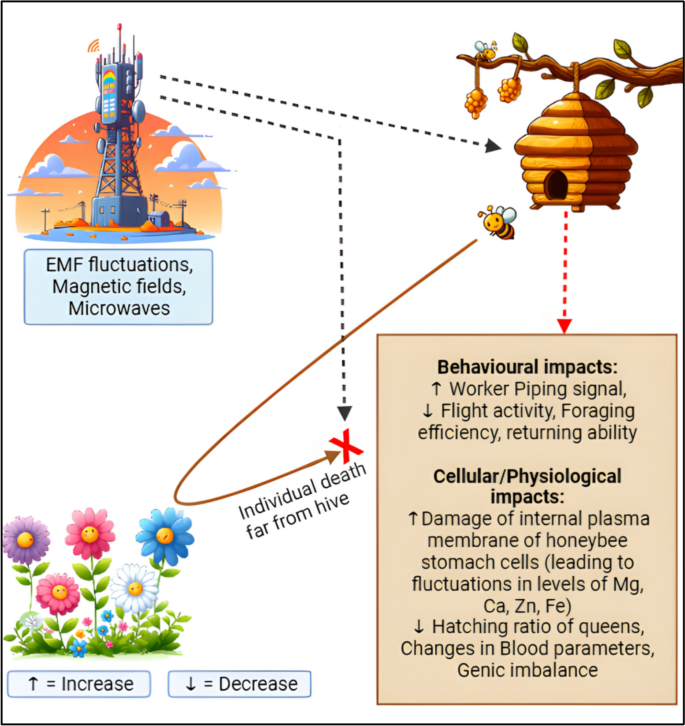
Fig. 3  Effects of electromagnetic fields on Honeybee health: EMF exposure is proposed to induce both behavioural changes (reduced foraging, increased distress signals, and impaired navigation) and cellular/physiological effects (membrane damage, mineral imbalances, reproductive impairment, stress markers, and genic imbalances). These changes can lead to individual bee death and potentially disrupt colony dynamics and survival, which can ultimately boost the process of colony collapse disorder​ Full size image

Singh G, Rana A. Honeybees and colony collapse disorder: understanding key drivers and economic implications. Proc. Indian Natl. Sci. Acad. (2025). https://doi.org/10.1007/s43538-025-00399-x

​Abstract

Biodiversity, including the diversity of pollinators such as honeybees, is crucial for ecosystem stability and sustainable development. This review highlights the complex factors contributing to Colony Collapse Disorder (CCD), focusing on inadequate bee management practices, pesticide exposure, biotic stressors, nutritional deficiencies, electromagnetic fields, and climate change. These stressors are shown to interact in ways that impair honeybee health and behavior, leading to colony declines. The paper details the biological consequences of CCD, including the absence of adult worker bees, the persistence of the queen, and the lack of dead bees within the hive. The economic impact of declining honeybee populations is significant, with losses affecting crop yields, food prices, and global trade. This decline threatens agriculture, particularly in regions dependent on pollination services. The review emphasizes the interconnectedness of honeybee health with broader ecological and economic systems, calling for urgent conservation measures, improved management practices, and sustainable agricultural strategies to mitigate the negative effects of CCD. Key recommendations for future research focus on the need for regional studies, long-term monitoring, and public education on the importance of honeybee conservation.

Electromagnetic fields and bee disappearance

One intriguing theory posits that the proliferation of telecommunications technology and the increasing prevalence of electromagnetic fields (EMFs) may play a role in CCD (Fig. 3) (Wyszkowska et al. 2019; Sahib 2011; Hill & Bartomeus 2016). Adult honeybees possess a magnetoreception sense akin to other animals, including birds, microbes, fishes, whales, dolphins, and insects. Like other organisms such as birds, microbes, fishes, whales, dolphins, and insects, adult honeybees are equipped with an impressive magnetoreception sense. This sense aids in navigation during migrations and long-distance travel (Ferrari 2014). It is postulated that magnetic fields, electromagnetic field fluctuations, and geomagnetic disturbances disrupt bees’ navigation systems, preventing their return to their hives (Ferrari 2014). In CCD the vanished bees never recover but are believed to die individually, far from their hives (Sahib 2011). Honeybees are known to detect Earth’s magnetic field, possibly using organized magnetic nanoparticles within their bodies (Liang et al. 2016; Lambinet et al. 2017). Thielens et al. conducted a study on the effects of radio-frequency electromagnetic fields (RF-EMFs) on Western honeybees (Thielens et al. 2020). Their study suggested that a modest transition in environmental incident power density, moving from frequencies below 3 GHz to higher frequencies, resulted in a notable rise in absorbed power. Active mobile phone handsets were found to have a profound impact on bee behaviour, inducing worker piping signals. Subsequent experiments confirmed these initial observations with controlled RF-EMF signal enhancements (Favre 2017). Mall and Kumar (2014) reported that radiofrequency and electromagnetic radiations can negatively impact biomolecular cells, ultimately impairing the biological structure and functions of organisms. Honeybees possess magnetic crystals in their fat bodies, and the effect of cell phone tower electromagnetic radiation on the foraging behaviour of Asiatic honeybees was observed (Taye et al. 2017). Observations included changes in returning ability, flight activity, and pollen foraging efficiency. Results revealed that colonies close to mobile phone towers were most affected, with flight activity and returning ability decreasing as proximity to the towers increased. RF-EMF from wireless devices and cell towers can cause changes in neurotransmitter functions, blood–brain barrier, morphology, calcium efflux, electrophysiology, cellular metabolism, and gene and protein expression in certain types of cells, even at low intensities (Sivani & Sudarsanam 2012). Exposure to mobile phone radiation has been shown to cause decay and damage to the internal plasma membranes of honeybee stomach cells, which in turn affect the levels of Mg, Ca, Zn, and Fe elements in the cells (Mahmoud & Gabarty 2021). Mobile phone radiation has been found to significantly reduce the hatching ratio of honeybee queens, but it did not adversely affect mating success. However, surviving queens were not negatively impacted after the exposure (Odemer & Odemer 2019).

Microwave radiation from mobile phones has been shown to cause adverse effects on different cell functions, including histological alterations in various visceral organs and changes in blood parameters in mice models (Yousif Al-Fatlawi 2022). Although Pollen foraging behavior did not show any significant difference, these findings underscore the potential harm of cell phone radiation on honeybee populations, which could have far-reaching consequences for ecosystems.

https://link.springer.com/article/10.1007/s43538-025-00399-x#Sec5

pdf: https://link.springer.com/content/pdf/10.1007/s43538-025-00399-x.pdf

--

Electromagnetic radiation as an emerging driver factor for the decline of insects

Alfonso Balmori. Electromagnetic radiation as an emerging driver factor for the decline of insects. Sci Total Environ. 767:144913. 
https://doi.org/10.1016/j.scitotenv.2020.144913.

Highlights

• Biodiversity of insects is threatened worldwide
• This reductions is mainly attributed to agricultural practice and pesticide use
• There is sufficient evidence on the damage caused by electromagnetic radiation
• Electromagnetic radiation may be a complementary driver in this decline
• The precautionary principle should be applied before any new deployment (e.g. 5G)

Abstract

The biodiversity of insects is threatened worldwide. Numerous studies have reported the serious decline in insects that has occurred in recent decades. The same is happening with the important group of pollinators, with an essential utility for pollination of crops. Loss of insect diversity and abundance is expected to provoke cascading effects on food webs and ecosystem services. Many authors point out that reductions in insect abundance must be attributed mainly to agricultural practices and pesticide use. On the other hand, evidence for the effects of non-thermal microwave radiation on insects has been known for at least 50 years. The review carried out in this study shows that electromagnetic radiation should be considered seriously as a complementary driver for the dramatic decline in insects, acting in synergy with agricultural intensification, pesticides, invasive species and climate change. The extent that anthropogenic electromagnetic radiation represents a significant threat to insect pollinators is unresolved and plausible. For these reasons, and taking into account the benefits they provide to nature and humankind, the precautionary principle should be applied before any new deployment (such 5G) is considered.

Excerpt

The precautionary principle and the importance of seriously considering EMR as a factor of insect decline

Despite the strong scientific evidence of the negative impacts of electromagnetic radiation on insects, a recent study funded by the European Union's Horizon 2020 Research and Innovation Programme (EKLIPSE) stated that our current knowledge concerning the impact of anthropogenic RF-EMR on pollinators (and other invertebrates) is inconclusive (Vanbergen et al., 2019). Thus, the extent to which anthropogenic EMR  represents a significant threat to insect pollinators is unresolved. For these reasons, and taking into account the benefits they provide to nature and humankind, the precautionary principle of the European Union (Communication from the Commission on the Precautionary Principle, 2000) should be applied.

The potential effects of RF-EMFs on most taxonomic groups, including migratory birds, bats and insects, are largely unknown, and the potential effects on wildlife could become more relevant with the expected adoption of new mobile network technology (5G), raising the possibility of unintended biological consequences (Sutherland et al., 2018). Thus, before any new deployment (such 5G) is considered, its effects should be clearly assessed, at least while conclusions are drawn and these existing uncertainties are overcome, according to the official document ‘Late Lessons of EarlyWarnings’ (European Environment Agency, 2013).

A letter by the United States Department of the Interior sent to the National Telecommunications and Information Administration in the Department of Commerce warns about the scarcity of studies carried out on the impacts from non-ionising EMR emitted by communication towers (United States Department of the Interior, 2014). The precise potential effects of increases in EMR on wildlife, which are not yet well recognised by the global conservation community, have been identified as an important emerging issue for global conservation and biological diversity (Sutherland et al., 2018). Thus, aswe have explained in this review, EMR should be seriously considered as a complementary driver for the dramatic decline in insects in recent studies, acting in synergy with agricultural intensification, pesticides, invasive species and climate change.


--

Review. The influence of bioactive mobile telephony radiation at the level of a plant community – Possible mechanisms and indicators of the effects

Czerwiński M, Januszkiewicz L, Vian A, Lázaro A. Review. The influence of bioactive mobile telephony radiation at the level of a plant community – Possible mechanisms and indicators of the effects. Ecological Indicators. 108, January 2020, 105683. https://doi.org/10.1016/j.ecolind.2019.105683.

Highlights

• There are various indicators of microwave radiation impact on herbaceous vegetation.
• The best indicators are some parameters of vegetation canopy or individual  plants.
• Specific plant functional groups may be indicators of long-term community processes.
• Other organisms interacting with plants, e.g. pollinators, should also be cons idered.
• The selection of indicators depends on the propagation of radiation in the canopy.

Abstract

Environmental exposure to radiofrequency electromagnetic fields (RF-EMFs) from mobile telephony has rapidly increased in the last two decades and this trend is expected to continue. The effects of this exposure at plant community level are unknown and difficult to assess in a scientifically appropriate manner. Such an assessment can be scientifically adequate if a studied plant community is completely new and control-impact radiation treatment is used.

In this review we aimed to predict ecological effects and identify indicators of the impact of bioactive RF-EMFs at the mobile telephony frequency range on plant communities. We considered the scenario where a plant community was exposed to radiation generated by a base transmitting station antenna mounted on a nearby mast. This plant community can be represented by mesic meadow, ruderal or arable weed community, or other herbaceous, moderately productive vegetation type. We concentrated primarily on radiation effects that can be recorded for a year since the exposure started. To predict them we used physical theories of radiowave propagation in vegetation and the knowledge on plants physiological responses to RF-EMF. Our indicators can be used for the detection of the impact of RF-EMFs on vegetation in a control-impact experiment.

The identified indicators can be classified into the following groups: (1) canopy parameters; (2) plant characteristics to be measured in the field or laboratory in a number of individuals that represent the populations of selected species; (3) community weighted means/medians (CWMs) of plant traits and strategies; (4) the abundance of other organisms that interact with plants and can influence their fitness or population size. The group of canopy parameters includes mean height, vertical vegetation structure and dry weight of above-ground standing phytomass. Plant characteristics requiring biometric sampling in the field are plant height, the number of fruits and seeds, as well as seed viability. The group of plant traits that are calculated as CWMs covers seed releasing height, seed dispersal mode, SLA, leaf orientation, month of germination and flowering, Ellenberg’s light indicator value, and the proportion of individuals in the classes of competitors and stress tolerators according to Grime's CSR strategy scheme. The group of “non-plant” indicators includes primarily the frequency of flower visits by beetles, wasps, hoverflies, and bees that have their nests over ground. To detect ecological responses that occur for the first year since a herbaceous community has been exposed to potentially bioactive RF-EMF, the first two indicators groups should be used.


Aug 1, 2019 (Updated Nov 1, 2019)

Selected Studies that Reported Adverse Effects of Electromagnetic Field (EMF) Exposure 
on Plants, Animals and Insects

written by the Advisors to the International EMF Scientist Appeal, June 25, 2019


EMF exposure studies have found ...

in plants reduced growth, increased infection and physiological and morphological changes (Balodis et al. 1996, Haggerty 2010, Waldmann-Selsam et al. 2016, Havas and Symington 2016, Vian et al. 2016, Halgamuge 2017);

in birds, aggressive behavior, impaired reproduction and interference with migration (Southern 1975, Larkin and Sutherland 1977, Balmori 2004, Balmori and Hallberg 2007, Everaert and Bauwens 2007, Fernie et al. 2010, Engels et al. 2015, Wiltschko et al. 2015);

in livestock, especially dairy cows, reduced productivity, impaired reproduction, and sudden death (Burchard et al. 1996, Loscher and Kas 1998, Hillman et al. 2013, Stetzer et al. 2016);

in rodents, increased cancer risk in three long-term studies (Chou et al 1992, NTP 2018, Falcioni et al. 2019); 

in amphibians (Balmori 2006, Balmori 2010) and insects (Cucurachi et al. 2013), deformities and population decline; and

in honey bees, aggressive behavior, reduced learning, reduced productivity, swarming and abandoning hives (Harst et al. 2006, Pattezhy 2009, Warnke 2009, Favre 2011, Kumar et al. 2011, Sahib 2011, Shepherd et al. 2019). 

References

Balmori A. 2004. Effects of electromagnetic fields of phone masts on a population of white storks (Ciconia ciconia). Electromagnetic Biology and Medicine 24: 109–119.

Balmori A. 2006. The incidence of electromagnetic pollution on the amphibian decline: Is this an important piece of the puzzle? Toxicological & Environmental Chemistry 88 (2): 287–299.

Balmori A. 2010. Mobile phone mast effects on common frog (Rana temporaria) tadpoles: the city turned into a laboratory. Electromagn Biol Med. 29 (1–2):31–35.

Balmori A and O Hallberg. 2007. The urban decline of the house sparrow (Passer domesticus): A possible link with electromagnetic radiation. Electromagnetic Biology and Medicine 26 (2): 141–151.

Balodis V, G Briimelis, K Kalviskis, et al. 1996. Does the Skrunda Radio Location Station diminish the radial growth of pine trees? The Science of the Total Environment 180: 57-64.

Burchard JF, DH Nguyen DH, and M Rodriguez. 2006. Plasma concentrations of thyroxine in dairy cows exposed to 60 Hz electric and magnetic fields. Bioelectromagnetics 27 (7): 553–559.

Chou C-K, A Guy, LL Kunz, RB Johnson, JJ Crowley and J. H. Krupp. 1992. Long-term, low-level microwave irradiation of rats. Bioelectromagnetics 13:469–496. See NTP: Not the First Govt. Study to Find Wireless Radiation Can Cause Cancer in Lab Rats

Cucurachi S, WLM Tamis et al. 2013. A review of the ecological effects of radiofrequency electromagnetic fields (RF-EMF), Environment International 51:116–140.

Engels S, N-L Schneider, N Lefeldt, et al. 2015. Anthropogenic electromagnetic noise disrupts magnetic compass orientation in a migratory bird. Nature 509: 353.

Everaert J and D Bauwens. 2007. A possible effect of electromagnetic radiation from mobile phone base stations on the number of breeding house sparrows (Passer domesticus) Electromagn Biol Med. 26 (1): 63–72.

Falcioni L, L Bua, E Tibaldi, et al. 2019. Report of final results regarding brain and heart tumors in Sprague-Dawley rats exposed from prenatal life until natural death to mobile phone radiofrequency field representative of a 1.8 GHz GSM base station environmental emission. Environmental Research 165:496–503. See Ramazzini Institute Cell Phone Radiation Study Replicates NTP Study

Favre D. 2011. Mobile phone-induced honeybee worker piping. Apidologie 42 (3): 270– 279.

Ferni KJ, NJ Leonard and DM Bird. 2010. Behavior of free-ranging and captive American kestrels under electromagnetic fields. J. Tox. and Environ. Health Part A Vol 59 (8).

Haggerty K. 2010. Adverse influence of radio frequency background on Trembling Aspen seedlings: Preliminary observations. International Journal of Forestry Research 2010, 7 pages.

Halgamuge MN. 2016. Review: Weak radiofrequency radiation exposure from mobile phone radiation on plants. Electromagn Biol Med. 2017;36(2):213-235.

Harst W, J Kuhn, and H Stever. 2006. Can electromagnetic exposure cause a change in behaviour? Studying possible non-thermal influences on honey bees–An approach within the framework of Educational Informatics. Acta Systematica – IIAS Intern. J. 6: 1–6.

Havas M and MS Symington. 2016. Effects of Wi-Fi radiation on germination and growth of garden cress (Lepidium sativum), broccoli (Brassica oleracea), red clover (Trifolium pratense) and pea (Pisum sativum) seedlings: A partial replication study. Current Chemical Biology 10 (1): 65–73.

Hillman D, D Stetzer, M Graham, CL Goeke, et al. 2013. Relationship of electric power quality to milk production of dairy herds – Field study with literature review. Science of the Total Environment 447: 500–514.

Kumar NR, S Sangwan and P Badotra. 2011. Exposure to cell phone radiations produces biochemical changes in worker honey bees. Toxicol Int. 18 (1): 70–72.

Larkin RP and PJ Sutherland. 1977. Migrating birds respond to Project Seafarer's electromagnetic field. Science. 195 (4280): 777–9.

Löscher W, and G Käs. 1998. Extraordinary behavior disorders in cows in proximity to transmission stations. Translated from German language. Der Praktische Tierarz 79 (5): 4377 444.

NTP 2018. NTP Technical Report on the Toxicology and Carcinogenesis Studies in Hsd:Sprague Dawley SD Rats exposed to Whole-body Radio Frequency Radiation at a Frequency (900 MHz) and Modulations (GSM and CDMA) used by Cell Phones. National Toxicology Program, National Institutes of Health, Public Health Service, U.S. Department of Health and Human Services. 384 pp. See NTP Cell Phone Radiation Study: Final Reports

Pattazhy S. 2009. Mobile phone towers a threat to honey bees: Study. The Times of India, August 2009. http://timesofindia.indiatimes.com/NEWS/Science/Mobile-phonetowers-a-threatto-honeybees-Study/articleshow/4955867.cms.

Shepherd S, Hollands G, Godley VC, Sharkh SM, Jackson CW, Newland PL. Increased aggression and reduced aversive learning in honey bees exposed to extremely low frequency electromagnetic fields. PLoS One. 2019 Oct 10;14(10):e0223614. doi: 10.1371/journal.pone.0223614.

Southern WE. 1975. Orientation of gull chicks exposed to project Sanguine's electromagnetic field. Science. 189 (4197): 143–145.

Stetzer D, AM Leavitt, CL Goeke, and M Havas. 2016. Monitoring and remediation of on-farm and off-farm ground current measured as step potential on a Wisconsin dairy farm: A case study. Electromagnetic Biology and Medicine 35 (4): 321–336.

Vian, A, E Davies, M Gendraud and P Bonnet. 2016. Plant responses to high frequency electromagnetic fields, BioMed research International Vol. 2015 Article ID 1830262, 13 pp.

Waldmann-Selsam, A Balmori-de la Puente, H Breunig and A Balmori. 2016. Radiofrequency radiation injures trees around mobile phone base stations. Science of the Total Environment 572: 13 554–569.

Warnke U. 2009. Bees, birds and mankind. Destroying nature by ‘electrosmog’ effects of wireless communication technologies, A brochure series by the Competence Initiative for the Protection of Humanity, Environment and Democracy, 47 pp.

Wiltschko R, P Thalau, D Gehring, C Niessner, T Ritz and W. Wiltschko. 2015. Magnetoreception in birds: the effect of radio-frequency fields. J R Soc Interface 12(103).

--

Increased aggression and reduced aversive learning in honey bees exposed to extremely low frequency electromagnetic fields

Shepherd S, Hollands G, Godley VC, Sharkh SM, Jackson CW, Newland PL. Increased aggression and reduced aversive learning in honey bees exposed to extremely low frequency electromagnetic fields. PLoS One. 2019 Oct 10;14(10):e0223614. doi: 10.1371/journal.pone.0223614. 


Abstract

Honey bees, Apis mellifera, are a globally significant pollinator species and are currently in decline, with losses attributed to an array of interacting environmental stressors. Extremely low frequency electromagnetic fields (ELF EMFs) are a lesser-known abiotic environmental factor that are emitted from a variety of anthropogenic sources, including power lines, and have recently been shown to have a significant impact on the cognitive abilities and behaviour of honey bees. Here we have investigated the effects of field-realistic levels of ELF EMFs on aversive learning and aggression levels, which are critical factors for bees to maintain colony strength. Bees were exposed for 17 h to 100 μT or 1000 μT ELF EMFs, or a sham control. A sting extension response (SER) assay was conducted to determine the effects of ELF EMFs on aversive learning, while an intruder assay was conducted to determine the effects of ELF EMFs on aggression levels. Exposure to both 100 μT and 1000 μT ELF EMF reduced aversive learning performance by over 20%. Exposure to 100 μT ELF EMFs also increased aggression scores by 60%, in response to intruder bees from foreign hives. These results indicate that short-term exposure to ELF EMFs, at levels that could be encountered in bee hives placed under power lines, reduced aversive learning and increased aggression levels. These behavioural changes could have wider ecological implications in terms of the ability of bees to interact with, and respond appropriately to, threats and negative environmental stimuli.


Open access paper: https://journals.plos.org/plosone/article?id=10.1371/journal.pone.0223614

--

April 17, 2019

Letter to the National Park Service from the Environmental Health Trust

This thirteen page letter to the National Park Service from the Environmental Health Trust, dated April 10, 2019, summarizes the scientific basis for major health and environmental concerns about a proposal to install wireless telecom facilities in Grand Teton National Park.

The letter summarizes research on harm to the environment and wildlife from wireless radiation exposure. Furthermore, it addresses the following topics: (1) research on harm to humans; (2) rapid increase in wireless radiation exposure; (3) inadequacy of the Federal Communications Commission's exposure limits to protect humans; (4) greater susceptibility of children; (5) recent appeals from hundreds of experts to reduce exposure limits; and (6) other cell tower safety hazards. 

This well-documented letter (81 references) can be downloaded from the following link:


--

July 18, 2016

A Briefing Memo by Dr. Albert Manville

Albert M. Manville, II, Ph.D. A Briefing Memorandum: What We Know, Can Infer, and Don’t Yet Know about Impacts from Thermal and Non-thermal Non-ionizing Radiation to Birds and Other Wildlife — for Public Release. July 14, 2016.


In this memo, Dr. Manville reviews the scientific literature that examines the impacts on wildlife from exposure to radio frequency radiation. 

He observes that although the FCC has standards to protect humans from the heating  (i.e., thermal) effects of wireless radiation exposure from cellular and broadcast towers, no standards exist to protect wildlife from thermal or non-thermal effects:

“The radiation effects on wildlife need to be addressed by the Federal Communications Commission (FCC), the Environmental Protection Agency (EPA), the Department of Commerce, the U.S. Fish and Wildlife Service (FWS) and other governmental entities.”

Dr. Manville concludes with the following statement:

“In summary, we need to better understand … how to address these growing and poorly understood radiation impacts to migratory birds, bees, bats, and myriad other wildlife. At present, given industry and agency intransigence … massive amounts of money being spent to prevent addressing impacts from non-thermal radiation — not unlike the battles over tobacco and smoking — and a lack of significant, dedicated and reliable funding to advance independent field studies, … we are left with few options. Currently, other than to proceed using the precautionary approach and keep emissions as low as reasonably achievable, we are at loggerheads in advancing meaningful guidelines, policies and regulations that address non-thermal effects....”

Dr. Manville recommends that the U.S. adopt the following recommendations because federally-protected wildlife species are currently in danger from RFR exposure:

“We desperately need to conduct field research on thermal and non-thermal radiation impacts to wild migratory birds and other wildlife here in North America, similar to studies conducted in Europe….”

“Studies need to be designed to better tease out and understand causality of thermal and non-thermal impacts from radiation on migratory birds…. efforts need to be made to begin developing exposure guidelines for migratory birds and other wildlife …”

“To minimize deleterious radiation exposures, these guidelines should include use of avoidance measures such as those developed by the electric utility industry for bird collision and electrocution avoidance …”

“Studies need to be conducted on the use of “faux” branches (i.e., metal arms that mimic pine or fir branches) on cell and/or FM towers intended to disguise the towers as trees, but provide nesting and roosting opportunities for migratory birds including Bald Eagles, which will almost certainly be impacted both by thermal and non-thermal radiation effects.”

“Agencies tasked with the protection, management, and research on migratory birds and other wildlife … need to develop radiation policies that avoid or minimize impacts to migratory birds and other trust wildlife species.”

“As Levitt and Lai (2010) concluded, we do not actually need to know whether RFR effects are thermal or non-thermal to set exposure guidelines. Most scientists consider non-thermal effects as well established, even though the implications are not fully understood.”

“Given the rapidly growing database of peer-reviewed, published scientific studies (e.g., http://www.saferemr.com, School of Public Health, University of California, Berkeley), it is time that FCC considers thermal and non-thermal effects from EMR in their tower permitting, and incorporates changes into their rulemaking regarding ‘effects of communication towers on migratory birds.’”


Dr. Albert Manville II is an adjunct faculty member at Johns Hopkins University. He served as a senior wildlife biologist with the U.S. Fish and Wildlife Service from 1997 to 2014.  He chaired the Communication Tower Working Group, partnering with the communications industry, federal and state agencies, researchers, and non-profit organizations. He testified more than 40 times before Congress and other governmental bodies and published more 170 papers. For more information, see http://advanced.jhu.edu/about-us/faculty/albert-manville/.

Dr. Manville’s memo is available at http://bit.ly/Manvillewildlife.


Monday, January 13, 2025

AirPods: Are Apple’s New Wireless Earbuds Safe? (Blood-Brain Barrier research)

Fourth-Generation AirPods

The fourth generation of Apple's AirPods (aka AirPods 4) was introduced in 2024. 

The Specific Absorption Rate (or SAR) for the right AirPod is 0.11 watts per kilogram (assessed with the earbud facing the flat phantom and averaged over 1 gram of tissue)The SAR for the left AirPod is 1.19 watts per kilogram (assessed with the earbud's back facing the flat phantom and averaged over 1 gram of tissue) (1).


Third-Generation AirPods

The third generation of Apple's AirPods (aka AirPods 3) was introduced in 2021. 

The Specific Absorption Rate (or SAR) for the right AirPod is 0.626 watts per kilogram (assessed via the flat phantom & averaged over 1 gram of tissue) (1). The SAR for the left AirPod is 0.614 watts per kilogram (2). 

(2) https://fccid.io/BCG-A2564/RF-Exposure-Info/13685813-S1V2-FCC-Report-SAR-5479999


April 2, 2019

Second-Generation AirPods

The newly-released second generation of Apple's AirPods (aka AirPods 2) emits Bluetooth microwave radiation in the 2.402 – 2.480 GHz frequency range to communicate with a smart phone or other wireless device.

The Specific Absorption Rate (or SAR) for the right AirPod is 0.581 watts per kilogram (averaged over 1 gram). (1) The SAR for the left AirPod is 0.501 watts per kilogram. (2)

News about the potential health risks from use of wireless headsets first went viral in 2016 (see posts below). This story has gone viral again at this time for the following reasons:
  • Apple announced that it is taking orders for a new version of its wireless headset, AirPods (aka AirPods 2).
  • In the past year, two major studies found conclusive evidence that microwave radiation caused cancer in rats. These studies conducted by the National Toxicology Program in the U.S. and the Ramazzini Institute in Italy received worldwide media coverage.
  • The proliferation of new cell towers and antennas in preparation for the deployment of 5G,fifth generation cellular technology, has stimulated many people to seek out information about the health effects from exposure to the radiation these antennas emit on a 24-7 basis in their neighborhoods.
  • More people now realize we cannot trust governments to protect us from environmental toxins. Industry has too much influence over government regulatory agencies, and governments have conflicts of interest because the telecom industry pays governments substantial taxes and fees.
For some Bluetooth devices like Apple’s AirPods, the Specific Absorption Rate (SAR), a measure of the body’s maximum exposure to microwave radiation, exceeds that of many smart phones. Moreover, the cumulative exposure to radiation from wireless headsets may be substantial since many users keep these devices on their head for hours at a time and use them to listen to music or podcasts.

I have found only two small studies that examined the short-term effects on hearing from exposure to Bluetooth, the communications standard use in AirPods and other wireless headsets (see below). The health effects from long-term exposure to this type of microwave radiation have not been studied.

The FCC minimum exposure levels were adopted in 1996 based largely upon recommendations from industry-funded scientists and engineers. The guidelines were designed only to protect us from short-term heating risks. We now have hundreds of studies that show harmful biologic and health effects from long-term exposure to low levels of microwave radiation that do not involve heating. The guidelines need to be updated to protect us from these effects.

Although there is no consensus regarding a safe level of exposure to microwave radiation, most scientists who have published research on the effects of this radiation agree that the current exposure limits are much too permissive. In fact, more than 240 scientists from 42 nations who have published peer-reviewed research on electromagnetic fields and biology or health totaling over 2,000 papers in professional journals have signed the International EMF Scientist Appeal which calls for stronger exposure limits and health warnings. 

Most wireless safety tips recommend the use of wired headsets or hands-free use of smart phones and other electronic devices instead of wireless headsets.

News Stories

Are AirPods and Other Bluetooth Headphones Safe?
Markham Heid, Medium, March 7, 2019
https://medium.com/s/the-nuance/are-airpods-and-other-bluetooth-headphones-safe-214a0449e13a

Are wireless earbuds dangerous? Experts warn that Apple’s AirPods could send an electromagnetic field through your brain
Natalie Rahhal, Daily Mail, March 11, 2019 Revised March 12

Scientists warn wireless, Bluetooth devices may carry cancer risk

Healio: Hematology/Oncology Today, March 13, 2019
http://bit.ly/BTHealio

Earpods for Cell Phones — Are There Health Risks?

Roxanne Nelson, RN, BSN, Medscape Medical News, March 15, 2019
https://www.medscape.com/viewarticle/910453

Are Bluetooth Headphones Dangerous? Here’s What Experts Think
Julia Ries, Healthline, March 24, 2019 

Controversy surrounding safety of wireless earphones: News Focus 2 with Prof. Joel Moskowitz
This Morning, tbs eFM (Seoul, Korea), March 25, 2019 (10 minute audio)

Did 250 Scientists Warn that Apple Airpods Pose a Cancer Risk?
Bethania Palma, Snopes, March 28, 2019
References

(1) UL Verification Services, Inc. SAR Evaluation Report for Bluetooth Earbud. FCC ID: BCG-A2032. Model Name: A2032. Report Number: 12458150-S2V1. Issue Date: 3/15/2019. Fremont, CA. https://fccid.io/BCG-A2032/RF-Exposure-Info/12458150-S2V1-FCC-Report-SAR-4204549

(2) UL Verification Services, Inc. SAR Evaluation Report for Bluetooth Earbud. FCC ID: BCG-A2031. Model Name: A2031. Report Number: 12458150-S1V1. Issue Date: 3/15/2019. Fremont, CA. https://fccid.io/BCG-A2031/RF-Exposure-Info/12458150-S1V1-FCC-Report-SAR-4204479


December 13, 2016

Apple announced today that AirPods can be ordered online and will be available in stores next week. The wireless earbuds will be available in limited quantities in more than 100 countries and territories.

Apple originally planned to ship AirPods in October and has not explained the reason for the delay. The Wall Street Journal reported that the delay was due to problems with the Bluetooth wireless technology employed by this device.


September 12, 2016

Apple’s new AirPods are wireless earbuds that employ Bluetooth technology to communicate with your smart phone, laptop, or smart watch. 

According to Apple, “After a simple one-tap setup, AirPods are automatically on and always connected.”

The Specific Absorption Rate (SAR) for the AirPods

The right AirPod emits Bluetooth microwave radiation in the 2.402 – 2.480 GHz frequency range to communicate with a smart phone or other wireless device. The Specific Absorption Rate (or SAR) for the right AirPod is 0.466 watts per kilogram (averaged over 1 gram). (1) The SAR  for the left AirPod is 0.510 watts per kilogram. (2)

For more information about the SAR see my post on the iPhone 7.

If one uses the AirPods many hours a day, the cumulative exposure to the brain from this microwave radiation could be substantial. 

According to EE Times, the left AirPod communicates with the right AirPod using a different technology, "near field magnetic induction (NFMI)."

Although there is a substantial research literature on the health risks of exposure to magnetic fields, I am not aware of any biologic research that examines NFMI. Hence, this post focuses on the risks to the brain from exposure to Bluetooth radiation. 

Is Bluetooth safe?

The wireless industry argues that devices that use Bluetooth are safe because the microwave radiation emitted by such devices is low compared to FCC guidelines. The FCC requires the SAR to be 1.6 watts per kilogram or less.

More than 240 scientists who have published research on electromagnetic radiation safety believe that current national and international guidelines for exposure to radio frequency radiation are inadequate to protect human health (see the International EMF Scientist Appeal).

In August 2022, I found only two peer-reviewed studies have examined the effects of exposure to Bluetooth radiation. The studies which employed small samples evaluated the effects of brief exposure to Bluetooth radiation on the auditory system. Given the study limitations, the absence of significant effects is not surprising. These studies do not provide the basis to argue that long-term exposure to Bluetooth radiation is safe. 

The following new study suggests there may be long-term effects from Bluetooth exposure, "Epidemiological exploration of the impact of bluetooth headset usage on thyroid nodules using Shapley additive explanations method"

Zhou N, Qin W, Zhang JJ, Wang Y, Wen JS, Lim YM. Epidemiological exploration of the impact of bluetooth headset usage on thyroid nodules using Shapley additive explanations method. Sci Rep. 2024 Jun 21;14(1):14354. doi: 10.1038/s41598-024-63653-0.

Abstract

With an increasing prevalence of thyroid nodules globally, this study investigates the potential correlation between the use of Bluetooth headsets and the incidence of thyroid nodules, considering the cumulative effects of non-ionizing radiation (NIR) emitted by these devices. In this study, we analyzed 600 valid questionnaires from the WenJuanXing platform using Propensity Score Matching (PSM) and the XGBOOST model, supplemented by SHAP analysis, to assess the risk of thyroid nodules. PSM was utilized to balance baseline characteristic differences, thereby reducing bias. The XGBOOST model was then employed to predict risk factors, with model efficacy measured by the area under the Receiver Operating Characteristic (ROC) curve (AUC). SHAP analysis helped quantify and explain the impact of each feature on the prediction outcomes, identifying key risk factors. Initially, 600 valid questionnaires from the WenJuanXing platform underwent PSM processing, resulting in a matched dataset of 96 cases for modeling analysis. The AUC value of the XGBOOST model reached 0.95, demonstrating high accuracy in differentiating thyroid nodule risks. SHAP analysis revealed age and daily Bluetooth headset usage duration as the two most significant factors affecting thyroid nodule risk. Specifically, longer daily usage durations of Bluetooth headsets were strongly linked to an increased risk of developing thyroid nodules, as indicated by the SHAP analysis outcomes. Our study highlighted a significant impact relationship between prolonged Bluetooth headset use and increased thyroid nodule risk, emphasizing the importance of considering health impacts in the use of modern technology, especially for devices like Bluetooth headsets that are frequently used daily. Through precise model predictions and variable importance analysis, our research provides a scientific basis for the formulation of public health policies and personal health habit choices, suggesting that attention should be paid to the duration of Bluetooth headset use in daily life to reduce the potential risk of thyroid nodules. Future research should further investigate the biological mechanisms of this relationship and consider additional potential influencing factors to offer more comprehensive health guidance and preventive measures.


Low-intensity microwave radiation can open the blood-brain barrier

In 1975, Allan Frey published a paper in the Annals of the New York Academy of Sciences which reported that exposure to low intensity microwave radiation could open the blood-brain barrier in rats. Moreover, pulsed radio frequency waves (like Bluetooth) were more likely to produce this effect than continuous waves. (3)

The blood-brain barrier is a special layer of cells in the brain that prevents chemical toxins in the blood system from reaching the brain. Breaching this barrier could potentially lead to neurodevelopmental and neurodegenerative diseases and brain cancer.

More than a dozen peer-reviewed studies have replicated Frey's findingsexposure to low intensity microwave radiation can open the blood-brain barrier (see links below). (3)  

The effect of microwave radiation on the blood-brain barrier is nonlinear—it occurs with low intensity exposures but not at higher intensity exposures.

Although other published studies have failed to find the blood-brain barrier effect, these studies tended to use higher intensity exposures or employed small samples.

Recommendations

We may not be certain of the long-term risks of using Bluetooth devices, but why would anyone insert microwave-emitting devices in their ears near their brain when there are safer ways to use a cell phone?

I recommend the use of corded headsets or hands-free use of cell phones, not wireless earbuds. Moreover, one should never keep a cell phone next to your body, especially during a phone call, but also whenever the phone is powered on. For additional tips on how to reduce your exposure to wireless radiation see https://www.saferemr.com/2015/10/tips-to-reduce-your-wireless-radiation.html.

%%%
News coverage

In the past few days, numerous news stories have appeared citing industry-affiliated scientists who claim that AirPods are safe. Nonetheless, a few news reports have addressed the potential health risks from using AirPods:

·         CBS San Francisco"Apple Unveils iPhone 7 Without Headphone Jack"
·         Daily Mail“Could wireless headphones harm your health?”

Since the stories in the Daily Mail and CNN were posted on September 8, over two dozen online news stories have appeared that discuss the potential health risks from the microwave radiation emitted by AirPods.

References (updated 1/13/2025)

(1) UL Verification Services, Inc. SAR Evaluation Report for Wireless Headset. FCC ID: BCG-A1523. Model Name: A1523. Report Number: 16U23784-S6V1. Issue Date: 8/30/2016. Fremont, CA. https://fccid.io/document.php?id=3118442

(2) UL Verification Services, Inc. SAR Evaluation Report for Wireless Headset. FCC ID: BCG-A1722. Model Name: A1722. Report Number: 16U23784-S1V1. Issue Date: 8/30/2016. Fremont, CA. https://fccid.io/BCG-A1722/RF-Exposure-Info/16U23784-S1V1-FCC-SAR-Report-3118428.pdf

(3) 3 peer-reviewed studies that reported on the effects of brief exposure to Bluetooth radiation:

Zhou N, Qin W, Zhang JJ, Wang Y, Wen JS, Lim YM. Epidemiological exploration of the impact of bluetooth headset usage on thyroid nodules using Shapley additive explanations method. Sci Rep. 2024 Jun 21;14(1):14354. doi: 10.1038/s41598-024-63653-0. https://pmc.ncbi.nlm.nih.gov/articles/PMC11192738

Mandalà M, Colletti V, Sacchetto L, Manganotti P, Ramat S, Marcocci A, Colletti L. Effect of Bluetooth headset and mobile phone electromagnetic fields on the human auditory nerve. Laryngoscope. 2014 Jan;124(1):255-9. http://www.ncbi.nlm.nih.gov/pubmed/23619813

Balachandran R, Prepageran N, Rahmat O, Zulkiflee AB, Hufaida KS. Effects of Bluetooth device electromagnetic field on hearing: pilot study. J Laryngol Otol. 2012 Apr;126(4):345-8. http://www.ncbi.nlm.nih.gov/pubmed/22310164


(4) 16 peer-reviewed studies that reported significant evidence of opening of the blood-brain barrier from exposure to low-intensity microwave radiation:

Kizilçay AO, Tütüncü B, Koçarslan M, Gözel MA. Effects of 1800 MHz and 2100 MHz mobile phone radiation on the blood-brain barrier of New Zealand rabbits. Med Biol Eng Comput. 2024 Nov 16. doi: 10.1007/s11517-024-03238-1. https://pubmed.ncbi.nlm.nih.gov/39548043/ 

Sırav B, Seyhan N. Effects of GSM modulated radio-frequency electromagnetic radiation on permeability of blood-brain barrier in male & female rats. J Chem Neuroanat. 2016 Sep;75(Pt B):123-7  23. http://www.ncbi.nlm.nih.gov/pubmed/26723545

Tang J, Zhang Y, Yang L, Chen Q, Tan L, Zuo S, Feng H, Chen Z, Zhu G. Exposure to 900MHz electromagnetic fields activates the mkp-1/ERK pathway and causes blood-brain barrier damage and cognitive impairment in rats. Brain Res. 2015 Jan 15. http://www.ncbi.nlm.nih.gov/pubmed/25598203

Sirav B, Seyhan N. Effects of radiofrequency radiation exposure on blood-brain barrier permeability in male and female rats. Electromagn Biol Med. 2011 Dec;30(4):253-60. http://www.ncbi.nlm.nih.gov/pubmed/22047463

Sirav B, Seyhan N. Blood-brain barrier disruption by continuous-wave radio frequency radiation. Electromagn Biol Med. 2009;28(2):215-22. http://www.ncbi.nlm.nih.gov/pubmed/19811403

Nittby H, Brun A, Eberhardt J, Malmgren L, Persson BR, Salford LG. Increased blood-brain barrier permeability in mammalian brain 7 days after exposure to the radiation from a GSM-900 mobile phone. Pathophysiology. 2009 Aug;16(2-3):103-12. http://www.ncbi.nlm.nih.gov/pubmed/19345073

Söderqvist F, Carlberg M, Hansson Mild K, Hardell L. Exposure to an 890-MHz mobile phone-like signal and serum levels of S100B and transthyretin in volunteers. Toxicol Lett. 2009 Aug 25;189(1):63-6. http://www.ncbi.nlm.nih.gov/pubmed/19427372

Eberhardt JL, Persson BR, Brun AE, Salford LG, Malmgren LO. Blood-brain barrier permeability and nerve cell damage in rat brain 14 and 28 days after exposure to microwaves from GSM mobile phones. Electromagn Biol Med. 2008;27(3):215-29. http://www.ncbi.nlm.nih.gov/pubmed/18821198

Belyaev IY,  Koch CB, Terenius O, Roxström-Lindquist K, Malmgren LO, H Sommer W, Salford LG, Persson BR. Exposure of rat brain to 915 MHz GSM microwaves induces changes in gene expression but not double stranded DNA breaks or effects on chromatin conformation. Bioelectromagnetics. 2006 May;27(4):295-306. http://www.ncbi.nlm.nih.gov/pubmed/16511873

Salford LG, Brun AE,  Eberhardt JL,  Malmgren L,  Persson BR. Nerve cell damage in mammalian brain after exposure to microwaves from GSM mobile phones. Environ Health Perspect. 2003 Jun;111(7):881-3; discussion A408. http://www.ncbi.nlm.nih.gov/pubmed/12782486

Leszczynski D, Joenväärä S, Reivinen J, Kuokka R. Non-thermal activation of the hsp27/p38MAPK stress pathway by mobile phone radiation in human endothelial cells: molecular mechanism for cancer- and blood-brain barrier-related effects. Differentiation. 2002 May;70(2-3):120-9. http://www.ncbi.nlm.nih.gov/pubmed/12076339

Schirmacher A, Winters S, Fischer S, Goeke J, Galla HJ, Kullnick U, Ringelstein EB, Stögbauer F. Electromagnetic fields (1.8 GHz) increase the permeability to sucrose of the blood-brain barrier in vitro. Bioelectromagnetics. 2000 Jul;21(5):338-45. http://www.ncbi.nlm.nih.gov/pubmed/10899769

Fritze K, Sommer C, Schmitz B, Mies G, Hossmann KA, Kiessling M, Wiessner C. Effect of global system for mobile communication (GSM) microwave exposure on blood-brain barrier permeability in rat. Acta Neuropathol. 1997 Nov;94(5):465-70. http://www.ncbi.nlm.nih.gov/pubmed/9386779

Salford LG, Brun A, Sturesson K, Eberhardt JL, Persson BR. Permeability of the blood-brain barrier induced by 915 MHz electromagnetic radiation, continuous wave and modulated at 8, 16, 50, and 200 Hz. Microsc Res Tech. 1994 Apr 15;27(6):535-42. http://www.ncbi.nlm.nih.gov/pubmed/8012056

Persson BR, Salford LG, Brun A, Eberhardt JL, Malmgren L. Increased permeability of the blood-brain barrier induced by magnetic and electromagnetic fields. Ann N Y Acad Sci. 1992 Mar 31;649:356-8. http://www.ncbi.nlm.nih.gov/pubmed/1580510

Frey AH, Feld SR, Frey B. Neural function and behavior: Defining the relationship. Annals of the New York Academy of Sciences, 247: 433–439. 1975. 
http://www.ncbi.nlm.nih.gov/pubmed/46734