JAMA Oncology published a paper on radiofrequency
radiation written
by a Telecom industry spokesperson.
January 18, 2022 (Updated: Jan 21, 2022, April 21, 2022)
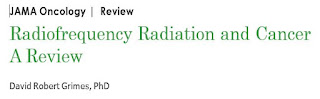
JAMA Oncology recently published a paper, "Radiofrequency
Radiation and Cancer: A Review,”
that provides a biased, highly selective review of the scientific literature written
by David Grimes, a pro-industry science writer and physicist:
Grimes DR. Radiofrequency Radiation and Cancer: A Review. JAMA Oncol. 2022 Mar 1;8(3):456-461. doi: 10.1001/jamaoncol.2021.5964. Erratum in: JAMA Oncol. 2022 Apr 21;: PMID: 34882171.
Importance: Concerns over radiofrequency radiation (RFR) and carcinogenesis have long existed, and the advent of 5G mobile technology has seen a deluge of claims asserting that the new standard and RFR in general may be carcinogenic. For clinicians and researchers in the field, it is critical to address patient concerns on the topic and to be familiar with the existent evidence base.
Observations: This review considers potential biophysical mechanisms of cancer induction, elucidating mechanisms of electromagnetically induced DNA damage and placing RFR in appropriate context on the electromagnetic spectrum. The existent epidemiological evidence in humans and laboratory animals to date on the topic is also reviewed and discussed.
Conclusions and relevance: The evidence from these combined strands strongly indicates that claims of an RFR-cancer link are not supported by the current evidence base. Much of the research to date, however, has been undermined by methodological shortcomings, and there is a need for higher-quality future research endeavors. Finally, the role of fringe science and unsubstantiated claims in patient and public perception on this topic is highly relevant and must be carefully considered.
--
Several experts who have worked in this field for decades
and two former U.S. government health officials wrote to me expressing their concerns about this paper:
- "The mentioned paper contains
hardly one page of actual review. It is trying to fixate the old paradigm
of not enough energy to cause harm. What a poor and pathetic attempt by
the industry proponents."
- "I could go on at length about
the flaws in his arguments ... I hope someone with
oncological/epidemiological clout in the community takes this crank to
task and highlights the enormous holes and one-sided nature of his
argument."
- "Confidentially, this is
garbage. Grimes gets this published because he is a naysayer. He claims to
discuss mechanisms, but only discusses his own irrelevant hobby horse.”
- "Grimes is going to get a bit
of scrutiny over this piece. It is really bad."
- "I think this needs to be
retracted."
On December 20, 2021, I sent the journal’s
editor-in-chief, Mary “Nora” Disis, MD, my comments along with a recommendation
that the journal retract the paper. Her response:
“The JAMA Network journals reserve
retractions for articles that have been fabricated, falsified, or plagiarized.
There does not appear to be evidence of such misconduct in this article.”
She suggested I submit a (400-word)
letter to the editor so the paper’s author could respond to my comments (with a
500-word letter). In my professional opinion, letters to the editor would not suffice
to undo the potential damage caused by publication of this industry propaganda
piece in a journal sponsored by the American Medical Association.
Since the
journal refused to retract the paper despite what I suspect was a flawed peer-review
process, the journal should change the paper’s title to accurately reflect its
contents (e.g., “Radiofrequency radiation and cancer: Telecom industry talking
points”). Moreover, the journal should publish a companion piece written by experts independent of the industry so the journal’s readers are not misled by an article
replete with industry sound bites.
My
critique of the Grimes paper appears below.
Also see the following links to articles and letters critiquing Grimes' paper:
Environmental Health Trust. Wireless Industry Spokesperson Pens Article on Wireless Health Effects for Top Academic Journal. January 18, 2022.
Environmental Health Trust. Documentation of inaccuracies, mischaracterizations and critical omissions in David Grimes’ JAMA Oncology review of RFR and Cancer. January 18, 2022.
Microwave News. Four Reasons Why David Grimes’s RF-Cancer Review Must Be Retracted: Open Letter to Editor-in-Chief, AMA Journals. January 18, 2022
Microwave News. David Robert Grimes Is Not Affiliated with University of Oxford. January 19, 2022
Paul D. Thacker. Experts Blast David Robert Grimes for His Failure to Understand Science and Love of Self-Citation. Journal of Scientific Practice and Integrity. January 18, 2022
Environmental Health Trust. Call for Retraction JAMA Skewed "Review" on Cell Phone Radio-Frequency Radiation. January 16, 2022. Open letter signed by Devra Davis, PhD, MPH; Linda S. Birnbaum, PhD [former director, National Institute for Environmental Health Sciences]; Ron Melnick, PhD [retired toxicologist, National Toxicology Program]; Dr. Anthony Miller [Professor Emeritus, University of Toronto], and Theodora Scarato.
Kent Chamberlin. Letter to Dr. Mary Disis, JAMA Oncology Editor. January 5, 2022
Paul D. Thacker. Physicist David Robert Grimes Finds Conspiracies Everywhere. The Disinformation Chronicle. December 7, 2021
--
A Critique of “Radiofrequency Radiation
and Cancer: A Review”
Joel M. Moskowitz, Ph.D.
School of Public Health
University of California, Berkeley
January 3, 2022
Grimes DR. Radiofrequency Radiation and
Cancer: A
Review. JAMA Oncol.
Published online December 09, 2021. doi:10.1001/jamaoncol.2021.5964. https://jamanetwork.com/journals/jamaoncology/article-abstract/2786776
The title of this paper, "Radiofrequency Radiation and
Cancer: A Review," is misleading because this is not a literature review.
Rather, this is an opinion piece written by David Grimes, a science
writer and physicist who has served as a paid spokesperson for the telecommunications
industry.
Following is a link to an “informational video” he recorded for
Vodafone UK:
The Grimes paper rehashes arguments I have heard for more than a decade. It reflects the perspective of some physical scientists and engineers since the 1980’s that only ionizing radiation is harmful due to photon energy. Their position is that radiofrequency radiation (RFR), or non-ionizing radiation, is harmless unless its intensity exceeds a certain heating threshold, and the only plausible mechanism for harm from RFR is acute heating. These scientists employ a common industry strategy to manufacture doubt about the science by dismissing thousands of peer-reviewed RFR studies published since the 1980's with the claim that these studies are not methodologically sound or have not been replicated.Grimes implies that anyone
concerned about health effects from 5G or RFR is a conspiracy theorist.
It is indeed unfortunate
that many people distrust science and believe in conspiracy theories. However, distrust
in government and the proliferation of conspiracy theories may be attributable
to a history of governmental failure to regulate environmental toxins and protect
public and environmental health instead of industry profits.
Grimes' paper
devotes five paragraphs to the discussion of the “biophysical overview” -- how
ionizing radiation can harm living organisms through direct action caused by the
energy in photons.
This overview
is a "straw man" argument used for decades to dismiss the
peer-reviewed research that found adverse biologic and health effects from
exposure to non-ionizing electromagnetic fields including radiofrequency
radiation (RFR). Although Grimes acknowledges that much of the damage caused by ionizing radiation is
through indirect action which requires much less energy than direct action, he ignores
the substantial body of peer-reviewed
research that has found
non-ionizing radiation including low-intensity RFR can also cause biologic harm
and adverse health effects through indirect actions.
Numerous peer-reviewed papers have been published that discuss
biophysical mechanisms for adverse RFR effects. Even though the mechanisms are
not fully understood, substantial empirical evidence exists that low-intensity RFR can
induce oxidative stress, reactive oxygen species (or free radicals), and stress
proteins via indirect action.

In contrast to
the paper’s claim, 65% (n=78) of 125 published studies of RFR found significant evidence of
DNA damage using the comet assay test.
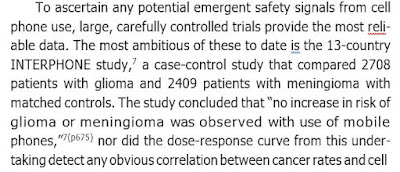
The paper failed
to mention that the Interphone study found significantly increased risk of
glioma, a malignant brain tumor, for those who used cellphones 1640 or more
hours in their lifetime. This effect held up in sensitivity analyses presented
in two appendices to the Interphone study paper. Moreover, Appendix 2 of that paper found a dose-response relationship between number of years of cellphone use and
incidence of glioma. Subsequent papers published using Interphone study data
provided additional support for increased risk of glioma for heavy cellphone
users, especially in proximity to the cellphone’s antenna and on the side of
the head where the cellphone was held.
Besides the
Interphone study, several case-control studies in Sweden and a French study
also found heavy cellphone use associated with increased
glioma risk. In
addition to the Interphone study, several other case-control studies found that
heavy cellphone use increased the risk of acoustic neuroma, a nonmalignant tumor on the nerve from
the ear to the brain, on the side of the head where the cellphone was held.

One would not
expect a “direct link” or a proportional increase in rates of common brain
tumors relative to adoption of cellphones because the latency between exposure
to a carcinogen and diagnosis of a solid tumor is often several decades. In the
U.S., there have been increases in specific brain tumors in some
anatomic locations since cellphones have become popular. Data from the National
Cancer Institute’s SEER cancer registry indicates that the incidence of glioblastoma,
the most common and serious malignant brain tumor, has increased in recent years while glioma incidence has declined.
This suggests that heavy long-term cellphone use promotes tumor growth. A study
in the UK obtained
similar results.
With the advent
of the smartphone about a decade ago, the transmitting antennas in many phones
are now located in the bottom, instead of the top, of the phone. Hence, the primary
tumor site for those who hold their phones to their ear may now be the thyroid gland instead of the brain. Two Yale University
studies found increased thyroid tumor risk with heavy cellphone use. Moreover,
the incidence of thyroid cancer has increased substantially in the U.S. and many
other countries. Smartphone use may have contributed to this increase.

The Danish
cohort cellphone study has been widely discredited (see responses to this study). The WHO International
Agency for Research on Cancer dismissed this study in its comprehensive report about RFR cancer risk due to the study’s misclassification
of many cellphone users as non-users and its lack of individual exposure data.The UK cohort study also suffered from misclassification
because exposure data were only collected at baseline and cellphone use likely changed
during the course of the study. Thus, neither of these cohort studies provides
a reliable assessment of brain tumor risk among cellphone users.
In Sweden brain
tumor incidence increased from 1998–2015. The incidence of glioblastoma increased
in Finland from
1990 to 2016 as well as in England
from 1995 to 2014.
In 2015 I
interviewed the "most knowledgeable person" at the U.S. FDA regarding
cell phone radiation risks, the head of the FDA Center for Devices and
Radiological Health who served as the agency’s representative to the
now-defunct federal Radiofrequency Interagency Working Group. He informed me
that every cellphone study that found evidence of harm had at least one
methodological problem; hence, the FDA dismissed all of these studies. Apparently,
little has changed in the ensuing years at the FDA.
As a researcher
for more than 30 years in the School of Public Health at the University of
California, Berkeley, I have never read a study without “inherent limitations.”
That no study is perfect is not a valid reason to exclude many hundreds of peer-reviewed
studies which found significant evidence of harm from RFR or cellphone
radiation.
The FDA review
paper was not subjected to an independent, external peer review process, unlike
the NTP cellphone radiation study discussed next.
Research
conducted by the National Toxicology Program (NTP) of the U.S. National
Institute of Environmental Health Sciences is considered the “gold standard” by
most toxicologists. The $30 million NTP cellphone study was one of the largest
animal studies ever conducted by the NTP so to criticize it for ”low-power” is
ludicrous. Prior to publication of the NTP reports, the study was subjected to extensive peer review and addressed the concerns of the
reviewers. The study’s methodology has also been defended in a peer-reviewed
paper.
The NTP study found
"clear evidence" of increased tumor incidence from long-term exposure
to cellphone radiation in male rats and DNA damage from shorter exposures to
male and female rats and mice. Two other major randomized, controlled animal studies,
the Ramazzini Institute study and a U.S. Air Force study, support the NTP’s finding that
long-term exposure to low-intensity (i.e. non-thermal levels of) RFR can cause
cancer.

The NTP study has
been attacked by pro-industry scientists because it demonstrates the inadequacy
of the RF exposure guidelines promoted by the ICNIRP, the IEEE, and the FCC. The
ICNIRP is a self-selected group of
scientists who believe
that non-thermal exposure to non-ionizing radiation including RFR is harmless.
Moreover, these pro-industry scientists have co-opted the WHO EMF Project and
biased many national health agency reviews of cellphone radiation health risks
according to multiple news stories published by Investigate Europe, a
multinational group of investigative journalists.
The IEEE or Institute
of Electrical and Electronics Engineers is a professional association for engineers.
Their committees that established RFR exposure limits were dominated by
engineers and physical scientists with little input from biologists or health
scientists.
The FCC, the
agency in the U.S. that regulates RFR exposure, has no health expertise and
relies on the FDA for advice; however, the FDA does no research on RFR health
effects. For more than two decades, the FCC has been “captured” by the
telecommunications industry according to a Harvard study. Most FCC commissioners have worked for
this industry before and after their appointments to the Commission.
The Grimes paper
is a prime example of a common industry tactic when a product or technology is
harmful to humans or the environment -- manufacture doubt about the state of
the science:
Despite Grimes’
claim, Michael Carlberg and Lennart Hardell applied the Bradford Hill criteria to the
peer-reviewed data and concluded that long-term exposure to cell phone
radiation is a causal factor for tumor risk. Hardell and his colleagues in Sweden were not the only researchers to conduct
case-control studies which found increased brain tumor risk with heavy
cellphone use. See also the 13-nation Interphone
study and a French
study.
Our
2020 review and meta-analysis
of the case-control tumor risk studies (Choi, Moskowitz et al., 2020) went
through extensive peer review prior to publication. Moreover, post-publication
we defended the paper against every criticism raised in two letters to the editor submitted by ICNIRP scientists and
their associates. Our quantitative review of 46 case-control studies “found
significant evidence linking cellular phone use to increased tumor risk,
especially among cell phone users with cumulative cell phone use of 1000 or
more hours in their lifetime (which corresponds to about 17 min per day over 10
years), and especially among studies that employed high quality methods.”

Although more is
to be learned regarding mechanisms, there are plausible biophysical mechanisms
for carcinogenesis due to RFR exposure. In contrast to the Grimes’ paper, for an
evidence-based perspective on the state of the science see a paper published in 2018 in the journal Environmental Pollution by Dominique Belpomme and colleagues, “Thermal
and non-thermal health effects of low intensity non-ionizing radiation: An
international perspective.”
More than 240 EMF
scientists, all of whom have published peer-reviewed papers on electromagnetic
fields (EMF) and biology or health totaling more than 2,000 papers and letters in professional journals have
endorsed the International EMF Scientist Appeal:
April 21, 2022
JAMA Oncology published three critical letters re: the Grimes' paper and Grimes' response:
Carpenter DO, Hardell L, Sage C. Evidence Base on the Potential
Carcinogenicity of Radiofrequency Radiation. JAMA Oncol. 2022 Apr 21.
doi: 10.1001/jamaoncol.2022.0928.
Naidenko OV. Evidence Base on the Potential Carcinogenicity of
Radiofrequency Radiation. JAMA Oncol. 2022 Apr 21. doi:
10.1001/jamaoncol.2022.0925.
Grimes DR. Evidence Base on the Potential Carcinogenicity of
Radiofrequency Radiation-Reply. JAMA Oncol. 2022 Apr 21. doi:
10.1001/jamaoncol.2022.0934.